Laboratory products
Published over 4 years ago. See the latest and most current information on Laboratory products.
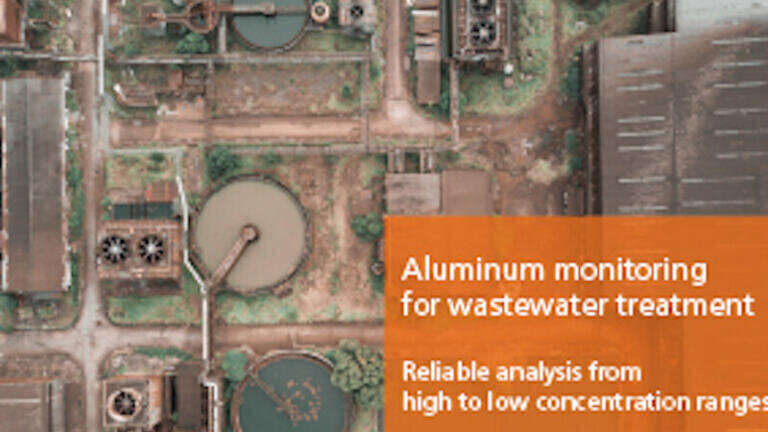
Aluminium salts, such as aluminium sulphate and polyaluminium chloride (PAC), are used as coagulation agent and flocculant for treatment of overloaded wastewater. For efficient wastewater treatment, the knowledge of the exact amount of aluminium, expressed as aluminium oxide (Al2O3) in the flocculant, is essential. This can be achieved rapidly and reliably by thermometric titration of the aluminium with sodium fluoride according to the newly revised standard ABNT NBR 11176. To learn more about this analysis, download the Application Note AN-T-224 from Metrohm.
Aluminium has a toxic effect on fish in acidic water and must therefore be removed before the release of the treated water into the environment. The European Union stipulates the monitoring of aluminium as an indicator parameter with a maximum content of 200 µg/L. Adsorptive stripping voltammetry (AdSV) allows the measurement of concentrations as low as 5 µg/L. Compared to atomic absorption spectroscopy (AAS) or Inductively Coupled Plasma Atomic Emission Spectrometry (ICP-AES), voltammetry is a viable alternative with only moderate investment in hardware required and low running costs. Download the Application Bulletin AB-131 from Metrohm to learn more.
ILM 51.6 Sept 2026


 Product directory