Laboratory products
Published over 13 years ago. See the latest and most current information on Laboratory products.
Inorganic and organic colloids are widespread in aquatic systems, where they influence many water quality treatment processes. Until recently there was a lack of an adequate analysis technique to measure the size fraction below 1000nm. The research group of Professor Mathias Ernst of the Institute of Water Resources and Water Supply at the Technical University Hamburg-Harburg has adopted the use of NanoSight’s NTA technique to provide new insights into water quality.
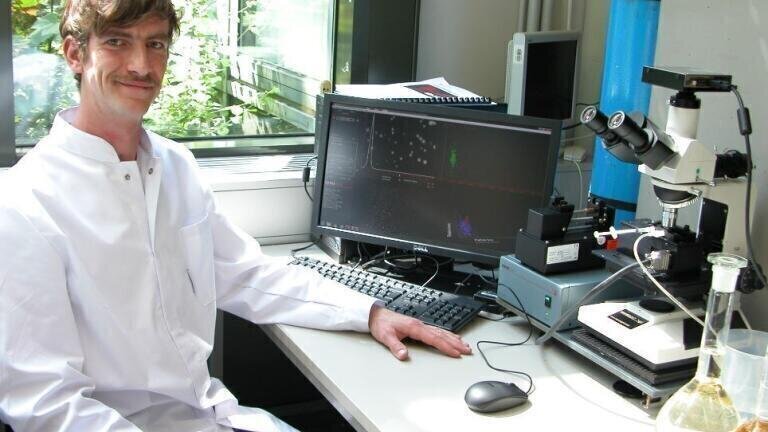
PhD student Martin Schulz began his research at the Berlin Centre of Competence for Water, where he first used NTA to assess different water treatment processes, in particular looking at particle & colloid removal and water purification methods. His work focused on membrane filtration where he encountered the problem of membrane-fouling when colloids would block the pores of the membrane. Schulz used NTA to predict the fouling potential of a water sample, thus providing time for the treatment plant to react with different pre-treatment options.
Schulz described the work of the Institute of Water Resources & Water Supply at TU-Hamburg-Harburg: “The institute provides professional support to water companies and our industry partners for the optimisation of processes, problem solving and innovation. We expect to offer NTA as a support tool to regional water companies who have problems with particles & colloids in their treatment processes and water distribution systems.”
Other techniques have been applied to this application with mixed success. These include LC-OCD (liquid chromatography-organic carbon detection) and flow cytometry (using fluorescence markers). NTA has proved to be the ideal complement as it is only by combining all of these techniques that full characterisation of a water sample over a broad size range can be established.
Speaking of the reasons why he feels NTA is ideal for this work, Schulz said: “NTA is perfect for the concentration range of water and wastewater samples. It provides reliable size detection in polydisperse samples which occur in almost all natural water samples. The fast and precise detection of the smallest colloid fraction (< 200nm) is a huge advantage. It also has potential for making on-line measurements. In simple words, we use NTA as an additional water quality parameter.”
ILM 51.6 Sept 2026



 Product directory















.jpg)
