Laboratory products
Published over 13 years ago. See the latest and most current information on Laboratory products.
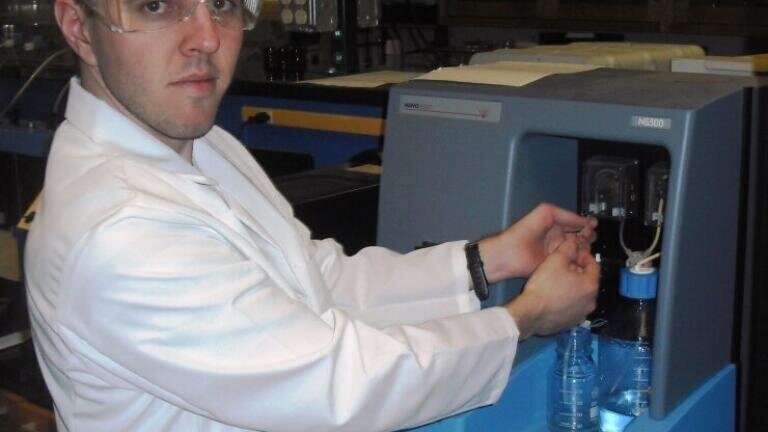
Dr Jonathan Brant is leader of the group, ‘Interfaces in the Environment: membranes, particles and nanotechnology’ in the College of Engineering and Applied Science at the University of Wyoming. The group focuses on problems associated with physicochemical processes in engineered and natural environmental systems. Understanding and ultimately controlling the many complex mechanisms that occur at environmental interfaces may resolve many of these problems. As is the case for environmental engineering as a whole, their work falls at the junction of many different disciplines, including colloid and interface science, chemical engineering, nanotechnology, microbiology and materials science.
Nanomaterials need to be characterised in terms of their size and distribution. Dr Brant explained the background to his work: "We have two primary research tracts. First, we characterise the properties of manufactured nano materials including TiO2, nano-Ag, C60 and maghemite of varying functionalities in aqueous systems. Secondly, we characterise the transformation of manufactured nano materials and their removal in conventional and advanced water treatment processes. In both instances, we have chosen NTA to characterise the size and size distribution of the particle suspensions under varying conditions. The latter area does this as well as quantifying the particle number concentrations in an effort to better understand the ‘dose’ or concentrations of nano materials in drinking water."
Describing his practical choices for NTA, Dr Brant continues: "I also use a dynamic light scattering (DLS) system from Malvern as well as TEM imaging (particle counting from images as well as geometry assessments from images). However, using NTA allows us to work with polydisperse suspensions (DLS is very limited in this respect) and it provides us with a number count for nano materials, which is a first step in better characterising nanoparticle concentrations. While the NTA may not be perfect here, it is our best option."
To find out about the company and to learn more about particle characterisation using NanoSight's unique Nanoparticle Tracking Analysis solutions, visit www.nanosight.com and register to receive the next issue of NanoTrail, the company's electronic newsletter.
ILM 51.6 Sept 2026



 Product directory




















.jpg)
