Laboratory products
Published over 17 years ago. See the latest and most current information on Laboratory products.
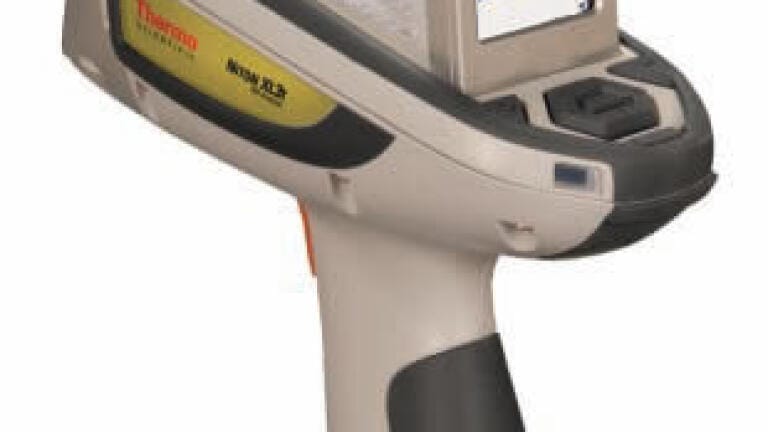
Thermo Fisher Scientific, Inc demonstrated its Scientific Niton XL3t Series with geometrically optimised large area drift detector (GOLDD™) technology at Pittcon 2009. The Niton analyser’s groundbreaking GOLDD technology delivers improvements in light element detection, overall sensitivity and measurement times – as much as 10 times faster than conventional Si-PIN detectors, and up to three times more precise than conventional smaller, silicon drift detectors.
Thermo Fisher Scientific was able to surpass the performance of conventional Si-PIN and SDD detectors by combining the award-winning Niton XL3t’s 50kV, 2-watt Xray tube, closely optimised geometry and patented signal processing hardware and software. When combined with the company’s proprietary large area drift detector, it creates GOLDD technology, delivering superior performance in the form of faster analysis and lower detection limits. Furthermore, this innovation allows light element detection of magnesium, aluminum, silicon, phosphorus and sulphur without helium or vacuum purging, a significant productivity and user benefit.
“The Niton XL3t with GOLDD technology brings true lab-quality performance to a handheld XRF analyser,” said Bob Wopperer, Director of Business Development for portable analyser products within Thermo Fisher Scientific. The Niton XL3t Series analysers with GOLDD technology incorporate 80 MHz real-time digital signal processing and dual state-of-the-art embedded processors for computation, data storage, live video processing and communication, and come with many standard features and available options. The standard Thermo Scientific Niton Data Transfer© (NDT) software, a suite of data management utilities, allows users to: customise the instrument; set user permissions; generate custom reports; print certificates of analysis personalised with a company’s own logo; and remotely monitor and operate the instrument hands-free from a PC or PDA. Integrated USB and Bluetooth communications provide direct data transfer to a PC or networked storage device. The NDT file format preserves and protects the data from each sample analysis, ensuring that this data is not unintentionally or intentionally compromised.
ILM 51.6 Sept 2026




 Product directory