Laboratory products
Published over 15 years ago. See the latest and most current information on Laboratory products.
Thermo Fisher Scientific, Inc announced that its Maybridge Ro3 Diversity Fragment Library has helped researchers validate an emerging technique for drug discovery that targets key protein receptors involved in a wide range of biological functions.
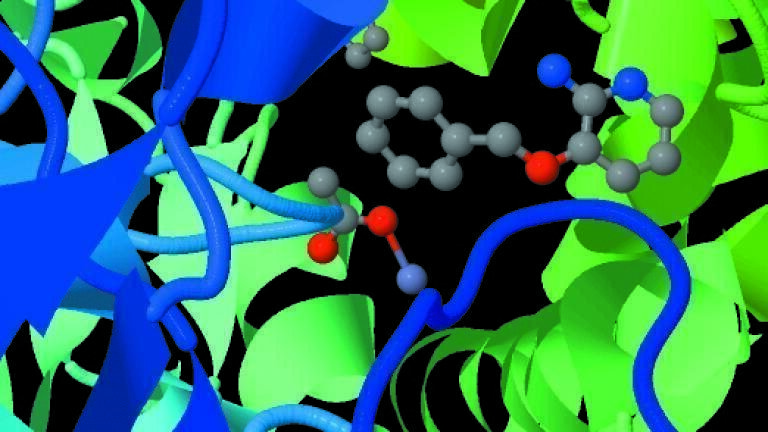
David Myszka, Founder of Biosensor Tools LLC and Director of the Centre for Biomolecular Interaction Analysis at the University of Utah, used surface plasmon resonance (SPR) to screen small molecules (fragments) in the Maybridge Ro3 collection against stabilised G-Protein Coupled Receptors (GPCRs) provided by Heptares Therapeutics. Several new classes of compounds were identified from the Ro3 library, which is accelerating drug discovery efforts around these receptors
Dr Myszka’s study demonstrated for the first time that fragment screening by SPR is an effective approach. It utilises the sensor surface to purify and concentrate solubilised tagged GPCRs and then characterise their binding activities with the fragments. Dr Myszka and Rebecca Rich, a research scientist in Dr Myszka’s group, recently presented their work: ‘Fragment Screening against Membrane Receptors using SPR’.
“While fragment screening by SPR has become standard practice, this is the first example of a successful SPR-based fragment screen against GPCRs,” said Dr Myszka. “One major factor contributing to our success was the integrity of the Maybridge Ro3 Fragments. The library was well behaved in terms of high solubility and displayed minimal nonspecific binding or so-called promiscuous binders. In addition, the structural diversity within this library allowed us to span a lot of chemical space, helping us to identify subsets of novel compounds that targeted two GPCRs. From the primary screen we identified thematic structural elements in the hits and then selected analogs from within the full Maybridge collection to investigate as confirmatory hits. With these follow-up studies in hand, we are now poised to pursue the next stage in elaborating compounds for drug development.”
“The guaranteed aqueous solubility of Maybridge Ro3 Fragments is not only key from a practical perspective, but it also provides an insight into likely ADME problems as the hits are evolved into drug-like molecules,” said Simon Pearce, Product Manager for Maybridge products at Thermo Fisher Scientific.
ILM 51.6 Sept 2026




 Product directory