.jpg)
Research news
Published over 2 years ago. See the latest and most current information on Research news.
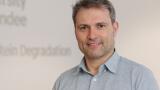
Innovative research led by Dr David Bajek, a researcher for the University of Dundee’s School of Medicine and NHS Tayside’s Photobiology Unit at Ninewells Hospital, has received the Silver Award for Physics at STEM for Britain, in recognition of the importance of his work in detecting skin cancer tumours without the use of invasive surgeries.
He has developed a handheld device containing infrared lasers the size of a penny, which operates using a technique similar to ultrasound by sending light into the body which is reflected back and creating an image of the layers of tissue inside. This Optical Coherence Tomography (OCT) method is already used by opticians looking into the eye but applying it to skin tissue is a more complex process. In the near future Dr Bajek’s device could not only be used to diagnose tumours, but also to more closely monitor areas which have previously been treated for cancer.
Dr Bajek was shortlisted from hundreds of applicants from across the UK to present in front of MPs at Westminster, during which time a panel of prestigious judges from STEM industries selected winners.
“I was surprised when the winners were announced,” he said, “I wasn’t expecting it. There’s a lot of remarkable research going on and the judges must have had a difficult job picking the winners because the research comes from a wide variety of important fields in physics.
“I am passionate about what I do and they said that came across when I was talking about my work.I’m really lucky that my desk [at Ninewells] is right next to where NHS patients are treated, which inspires me to do everything I can to help them.”
Dr Bajek also researches treatments for skin conditions including photosensitivity and the award was also in recognition of this area of his work, for example treating patients with conditions so extreme that just two or three minutes outside can cause severe burns, rashes and pain, while others can be sensitive to UV emitted by lightbulbs inside some environments.
“The thing that comes up time and time again with these patients is the lack of understanding at work or school,” he said of those with photosensitivity. “It’s terribly misunderstood and people don’t realise how life-altering it can be.”
In response to this, Dr Bajek is developing a number of medical and personal devices which will allow patients to monitor their exposure to light, as well as select the best protective clothing and sunscreens to manage their symptoms.
More information online
ILM 51.6 Sept 2026



 Product directory


.jpg)
.jpg)














,-photo-Karin-Allander.jpg)



.jpg)