Research news
Published over 2 years ago. See the latest and most current information on Research news.
An ambitious new programme that will equip students with hands-on space industry experience and training for their future careers, has launched as a collaborative venture between the Universities of Southampton, Portsmouth and Surrey together with Space South Central, the largest regional space cluster in the UK.
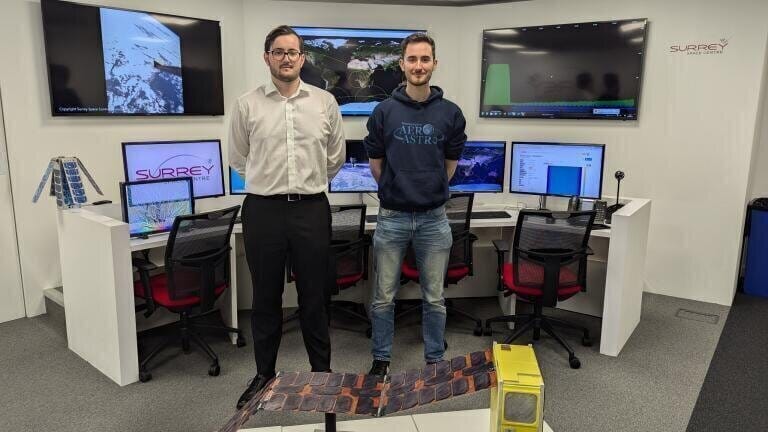
The inaugural programme of the Joint Universities Programme for In-Orbit Training, Education and Research, (JUPITER), has seen engineering and physics students from all three universities design, build and test their own Earth observation payload for a satellite mission. They will also be involved with its launch and once in orbit, conduct mission operations.
University of Southampton student Alejandro Parra Pintado, age 22, developed the software that drives data handling between the payload and satellite computer system.
He said: "It’s been a really rewarding experience and the project has greatly expanded my engineering knowledge while working on a real satellite that will be launched into space.
"We've learnt a lot about the engineering that goes into spacecraft development and I am sure this insight will launch my future career in aerospace engineering.
"Knowing that my work is going to blast off into space to collect data about our planet and help uncover the mysteries of dark matter is thrilling.”
The satellite, Jovian-1, will be around the size of a large shoe box and feature the payload resulting from the JUPITER initiative.
Its mission is to take images and videos of the Earth and attempt to use a space-facing camera to look for space debris. It will also feature elements of a future dark matter experiment undertaken by Southampton students, taking a first step in demonstrating the suitability of their hardware and concept for use in space.
Professor Hendrik Ulbricht from the University of Southampton, said: “This is a great opportunity for us to conduct a long-dreamed-of experiment in space.
“We have the unique chance to do a fundamental physics experiment and directly test for low-mass dark matter in space with our levitated mechanical sensors, which are at an early stage of development and will aid our research in the future.”
More information online
ILM 51.6 Sept 2026



 Product directory
















,-photo-Karin-Allander.jpg)