Mass spectrometry & spectroscopy
Published over 12 years ago. See the latest and most current information on Mass spectrometry & spectroscopy.
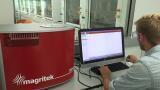
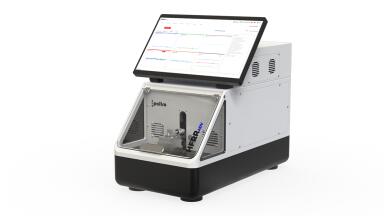
Magritek report on the use of their Spinsolve Benchtop NMR spectrometer for research at the Instituto de Quimica, University at Campinas in Brazil.
The Institute of Chemistry is dedicated to training students in chemistry and chemical technology as well as teachers of Chemistry. Professors Jose Jarbas and Pasquini Celio lead a group of research scientists in the use of NMR spectrometry. Their student, Mario Killner takes up the story.
Mario Killner spent a year in the renowned NMR laboratory of Professor Bernhard Bluemich at the Technical University of Aachen in Germany. He was working on the development of test methods to monitor biodiesel production. This was based on diesel fuel quality parameters developed in German industry. The success of this work led to the purchase of the Magritek Spinsolve Benchtop NMR spectrometer.
Describing his work, Mario talks first about previous experimental methods. "This is the first time that our group has had access to NMR in our laboratories. For a long time, our research group has been working mostly with NIR spectroscopy and, most recently, with Terahertz spectroscopy to develop new methodologies applying chemometric tools."
Continuing, he said, "Now we'd like to implement the NMR spectroscopy in our research starting with analysis of fuel. We want to create new methodologies applying NMR with chemometric tools for quality control of Brazilian fuels which will mainly be gasoline and diesel. We believe that the benefits of using NMR will be on the speed of analysis, the cost of analysis and also the possibility of automation sometime in the future."
Magritek's latest Spinsolve system allows 13C NMR Spectroscopy. It delivers more detail in its spectra than use of the more basic 1H nucleus. Carbon has a large chemical shift range of approximately 250 ppm and using composite pulse decoupling there is usually a single peak per carbon atom in the molecule making carbon spectra much more informative than proton spectra.
Furthermore, multinuclear and multidimensional experiments reveal additional structural information such as how carbon and proton atoms in the molecule are connected. This enables NMR to easily resolve isomers that are often confused with other analytical methods.
Magritek
ILM 51.6 Sept 2026





 Product directory