Microscopy & microtechniques
Published over 16 years ago. See the latest and most current information on Microscopy & microtechniques.
The revolutionary new Band Excitation (BE) technique, co-developed by Oak Ridge National Laboratory (ORNL) and Asylum Research, has provided clues to the origins of unique properties of materials including spin and
cluster glasses, phase-separated oxides, polycrystalline ferroelectrics, and ferromagnets, that are rooted in their highly disordered structures.
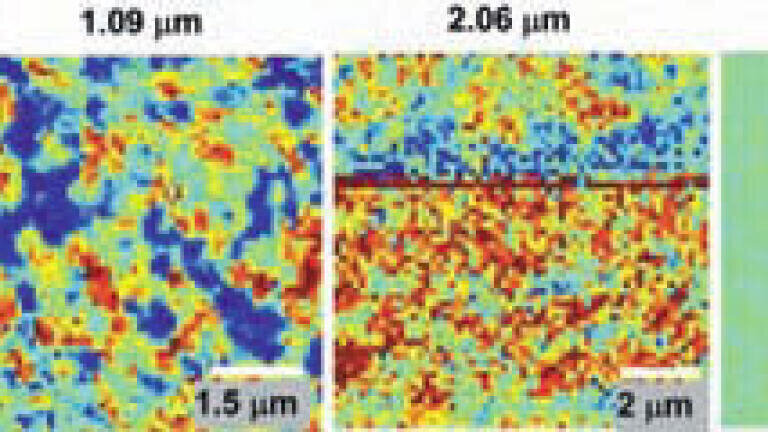
These behaviours influence the scaling properties of the materials, including the thickness of thin films at which improved properties manifest. So-called ‘Rayleigh behaviours’ have a direct bearing on the properties of nanoscale materials and, eventually, the uniformity of nanoscale devices. The new observations, which were made possible by advances in scanning probe microscopy (SPM) at ORNL’s Centre for Nanophase Materials Sciences and Asylum Research, may result in the rethinking of 100-year-old theories behind the ‘quanta of nonlinearity’ and properties of heterogeneous materials. This work is funded by the Department of Energy’s Basic Energy Sciences CNMS user program. The principal investigators for this ground breaking work are Stephen Jesse and Sergei Kalinin of ORNL, and Susan Trolier-McKinstry from Penn State.
Sergei Kalinin of ORNL, commented: “The nonlinear responses are a ubiquitous aspect of disordered materials that is directly linked to their unique functional properties. Our studies illustrate that the emergence of the nonlinear behavior is associated with large-scale collective responses, providing new clues to century-old problems.”
Added Roger Proksch, President of Asylum Research, added: "The amazing aspect of BE measurements is that the local nonlinearity is measured quantitatively with less than 10% absolute error in volumes millions of times smaller than those addressable by macroscopic measurements. This is highly unusual for SPM."
ILM 51.6 Sept 2026




 Product directory