
Microscopy & microtechniques
Published over 10 years ago. See the latest and most current information on Microscopy & microtechniques.
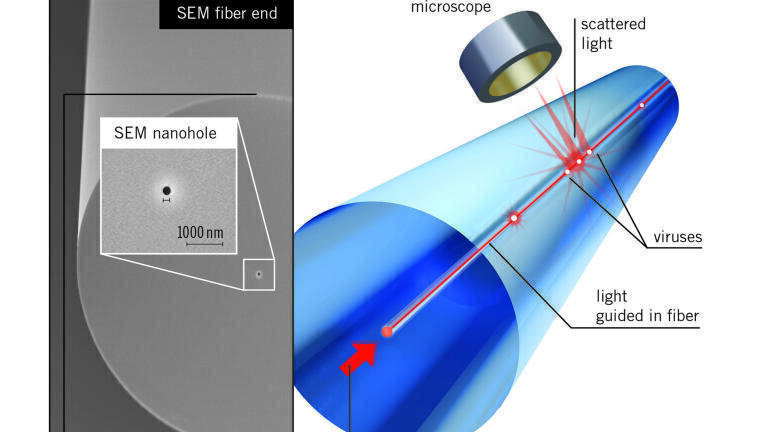
Scientists at the Leibniz Institute of Photonic Technology (IPHT) in Jena, in cooperation with others at Heraeus Quarzglas, Harvard University and Leiden University, have succeeded in the marker-free and nondestructive detection of viruses with dimensions smaller than 20 nanometers. They did so using an innovative nanohole fibre similar to an internet fibre and made of quartz glass from Heraeus. This pioneering advance makes it possible to observe viruses in their natural environment, without manipulation.
Heraeus Quarzglas worked with an IPHT research team to develop the fibre. The unusual glass fibre was produced right at the Heraeus facilities in Hanau. Stefan Weidlich, Physicist at Specialty Fiber Optics Research & Development at Heraeus Quarzglas, is pleased with the achievement: "Our application is distinguished by the fact that we put the viruses into quartz glass. The fibre itself conducts light almost perfectly, without scattering it. But as soon as the light encounters the virus, some of it is diffracted. This allows very rapid observations with an extremely limited background. As a result, the movement of a virus can be observed and recorded within a period of several seconds.“
The process begins with manufacturing the preform from high-purity quartz glass and ends with drawing the extremely sensitive nanohole fibres. In selecting and characterising the appropriate quartz glass material and developing the special, unusual design of the nanohole fibre, the technology group applied its combined expertise in the areas of telecommunications glass fibres and specialty fibres.
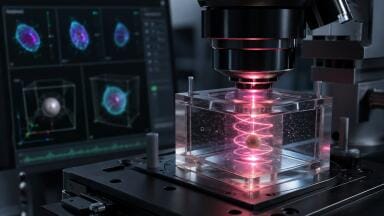
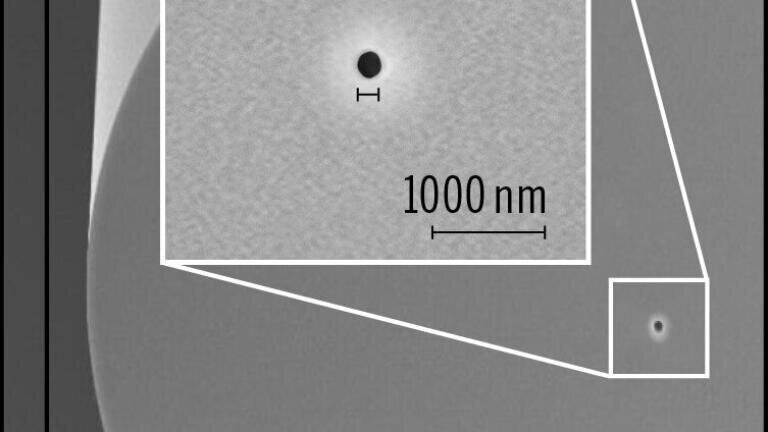
The core of the fibre contains a nanohole with a diameter of 200 nanometers that extends along the entire fibre. Test viruses swimming in water are poured into this hole, and light is fed into the fibre core. The size and movement of the viruses can be determined by means of light scattering. The transmission of light in an optical fibre is based on a refractive index that decreases from the core to the cladding. If the light fed into the capillaries encounters a virus, part of the light is diverted from its direction of propagation; that is, it is scattered. When this scattering is observed through a microscope, the size of the virus can be determined.
For Heraeus developer Stefan Weidlich, the use of the nanohole fibre to examine viruses is just the first of many applications. "We envision other fields of application in medicine, in life sciences and in sensor technology."
ILM 51.6 Sept 2026





 Product directory