Microscopy & microtechniques
Published over 10 years ago. See the latest and most current information on Microscopy & microtechniques.
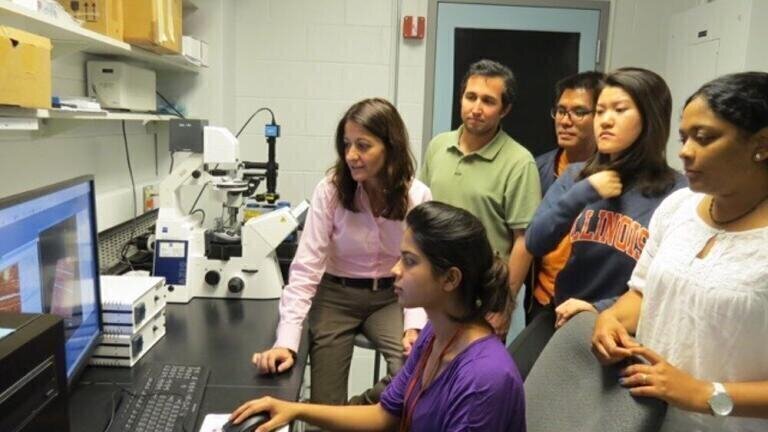
Dr Rosa M Espinosa-Marzal is an Associate Professor in the Department of Civil & Environmental Engineering at the University of Illinois at Urbana-Champaign. The central theme of her research group, Smart Interfaces in Environmental Nanotechnology (SIEN), is to design, synthesise, characterise and develop a fundamental understanding of bioinspired materials and of (bio) interfaces, also under nanoconfinement. AFM, is a vital tool for these studies.
Speaking about her group and their experiences since the starting of their use of the JPK NanoWizard® AFM system, Dr Espinosa-Marzal said: “My team of researchers is looking at a broad range of materials which require imaging in fluids to a high level resolution. The ability to measure low noise, high resolution force curves is of particular value as is the capability of working in liquid environments without the fear of damaging the piezo or sample.”
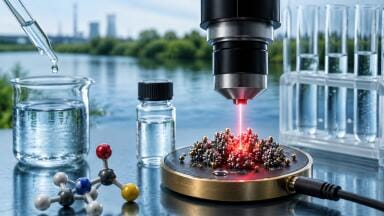
In one project which is setting out to understand the structure of water at the interface with 2D materials such as graphene, the biggest challenge is to make high resolution, force spectroscopy measurements. Operating in liquid the NanoWizard® has produced high resolution phase images in AC mode that reveal the contamination on the graphene surface. Ultimately, the group hopes to study the layering of water molecules and ions on the graphene surface, which can be used as a possible interface for water purification.
Imaging soft structures in aqueous environments is the challenge of the researchers developing model cell membranes. These require a low noise system to both image and perform nanomechanical characterisation with QI™ mode of individual layers and the complete stratified structure.
In a biofilm study, one researcher is looking to understand the precipitation of calcite in biofilms found in drinking water distribution systems. Here, colloidal AFM probes are applied to make surface force measurements on heterogeneous soft composites. These are used to determine mechanical forces of the films including adhesion and detachment forces. The combination of AFM with an inverted microscope has been invaluable here using JPK's patented Direct Overlay™ feature to identify appropriate areas to image and ultimately to generate force maps which allow the understanding of the spatial variability of the mechanical properties for mineralised and non-mineralised samples.
Other projects include the study of biomineralisation and how ionic liquids respond to nanoscale confinement and to surface heterogeneities.
ILM 51.6 Sept 2026



 Product directory


.jpg)
.jpg)









.jpg)
