Microscopy & microtechniques
Published over 12 years ago. See the latest and most current information on Microscopy & microtechniques.
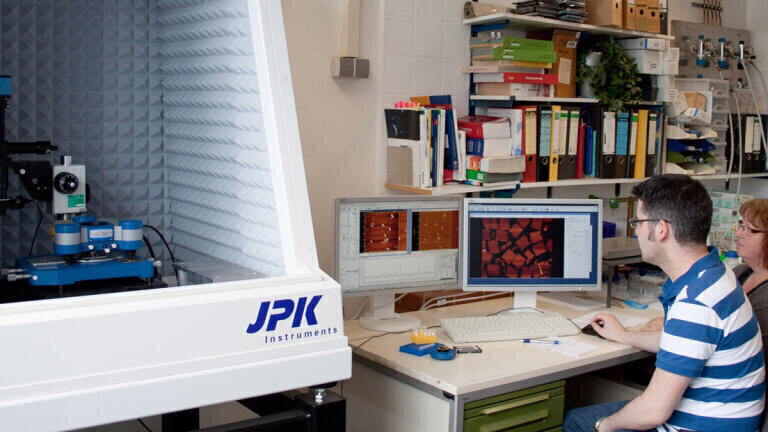
JPK Instruments reports on the use of their AFM system, the NanoWizard®, in the Nanobiosciences Group of the Institute of Physical & Theoretical Chemistry at the Technical University of Braunschweig. It is being used to study DNA and DNA nanostructures.
Dr Philip Tinnefeld is Professor of Biophysical Chemistry at the Technische Universität Braunschweig where he runs a laboratory which specialises in the field of NanoBioScience. His group has pioneered the integration of DNA origami with optical single-molecule spectroscopy over the last few years. In this context, they have demonstrated some of the early applications where the breakthroughs of DNA nanotechnology achieved by others could actually lead to practically useful products and assays. DNA nanostructures are applied for calibration standards known as ‘nanorulers’; as breadboards for energy transfer cascades and switches; as scaffolds for the production of nanoantennas; as biocompatible surfaces. Currently, the group is working on new amplification mechanisms for diagnostic applications.
Asked about his motivation to use atomic force microscopy, AFM, in his work, Dr Tinnefeld said: “In all our work with DNA as a material, AFM is one of the prime tools to characterise the DNA nanostructures. A first indication about the quality of DNA nanostructures comes from gel electrophoresis. The second tool is AFM. Other groups also use TEM but we don’t directly have this in the institute and only get images through cooperations. Finally, we often use fluorescence microscopy (super-resolution microscopy or FRET) for further characterisation. Our group comes from an optics background. We are specialists in single-molecule fluorescence microscopy and super-resolution microscopy. We also do time-resolved spectroscopy.”
On choosing a JPK system for this work, Dr Tinnefeld said: “We were not familiar with other SPM techniques. Through our initial cooperations when starting to work with DNA origami, we heard that the JPK NanoWizard works well when studying DNA origami. We tested it and it indeed delivered on this promise. Being inexperienced with scanning probe techniques, it was especially beneficial to have the support from the JPK team. They supported us through several visits until we got the hang of using the system”
ILM 51.6 Sept 2026




 Product directory