Microscopy & microtechniques
Published over 16 years ago. See the latest and most current information on Microscopy & microtechniques.
JPK Instruments reports on the work of the Stark research group at LMU-Munich in cooperation with the EURAC Bolzano where a NanoWizard® AFM system has been used to reveal the nanostructure and mechanics of
mummified type I collagen from the 5300-year-old Tyrolean Iceman.
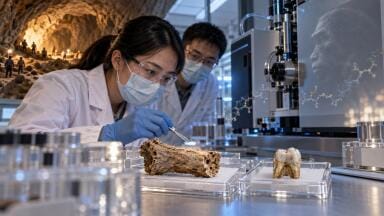
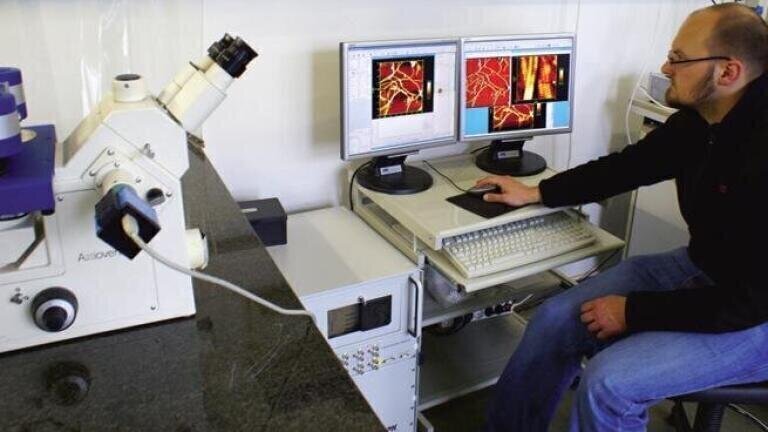
In the Department of Earth and Environmental Sciences at the Ludwig-Maximilians University in Munich, scientists work on nanoscale biomaterial characterisation. Their efforts have recently been showcased in the study of mummified skin from the 5300-year-old Tyrolean Iceman. By way of background, skin protects the body from pathogens and degradation. Even mummified skin retains this function. The action of micro-organisms or other external influences may degrade the connective tissue and lay the subjacent tissue open. To determine the degree of tissue preservation in mummified human skin and the reason for its durability, PhD-student Marek Janko of Professor Robert Stark’s research group has investigated the structural integrity of its main protein, type I collagen using an atomic for ce microscope, the NanoWizard® II, from JPK Instruments.
Janko’s research focuses on the study of mechanical properties of nanobio materials. Use of AFM and Raman spectroscopy are noninvasive techniques and samples may be reanalysed many times. The choice of the NanoWizard for this work is two-fold. The combination of AFM with optical microscopy enables normal histology tissue samples, 2-4 microns thick and relatively ‘rough’ to be readily studied in ambient conditions. The optical microscope enable identification of areas for study and then the AFM is used to effectively zoom in to study individual fibrils on the tens of nanometer scale. Being able to zoom to and study a single fibril just 30-40nm in height means the individual repeat units of 67nm may be identified and probed. This enables nanoindentation studies to be carried employing force-versus-distance measurements to measure mechanical properties and in particular, Young’s modulus.
ILM 51.6 Sept 2026





 Product directory