Microscopy & microtechniques
Published over 17 years ago. See the latest and most current information on Microscopy & microtechniques.
Virus particle detection and counting using Nanoparticle Tracking Analysis is providing essential information for
researchers at the University of Strathclyde’s Institute of Pharmacy and Biomedical Sciences (SIPBS). This team develops
methods to employ naturally occurring bacteriophages to combat MRSA (Methicillin resistant Staphylococcus aureus) and
other bacteria.
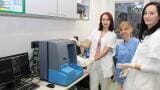
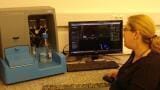
It is in characterising bacteriophage cultures that NanoSight comes into play, employed within a team lead by Dr Mike Mattey, Honorary Lecturer at SIPBS. Prior to deploying bacteriophages as a dry-coat, to protect high-risk bacterial invasion sites (sutures, instruments and wounds), the cultures need characterisation and their concentration needs assessing. NanoSight allows the team to view and size viral cultures rapidly, in real time and at low cost.
“The characterisation of virus populations requires assessment of aggregation in the 20nm – 1,000nm range,” says Dr Mattey.
“NanoSight provides fast and easy quantitative sample characterisation not possible with other methods and at a much
lower cost. Additionally, NanoSight’s technology provides a reassuring view of the particle population that supports the counting results.”
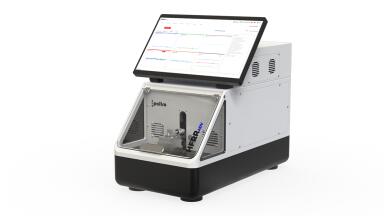
The NanoSight LM system uses a novel employment of laser light scattering. These instruments visualise and dynamically size populations of suspended particles on an individual basis down to a particle size of approx 20nm, dependent on material. NanoSight directly tracks the Brownian motion of each and every particle separately but simultaneously using a CCD camera and from a high-resolution plot of the particle size distribution profile. Aggregation and flocculation are immediately apparent. This particle-by-particle approach avoids the ensemble
assumptions of dynamic light scattering (DLS) and provides a unique image, going beyond light scattering in assessing polydisperse systems and providing insight into aggregation.
ILM 51.6 Sept 2026





 Product directory