Microscopy & microtechniques
Published over 15 years ago. See the latest and most current information on Microscopy & microtechniques.
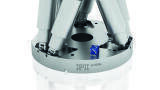
Scientists at the Institute for Gravitational Research, School of Physics and Astronomy, Glasgow University, have selected PI’s M-824 Hexapod, a 6-axis micropositioning system, to construct space flight hardware for the LISA (Laser Interferometer Space Antenna) Pathfinder space mission, a major ESA-NASA initiative.
Dr Christian Killow, a SUPA (Scottish Universities Physics Alliance) Advanced Fellow, explained: “Gravitational waves can pass through matter virtually unaffected, allowing us to see and measure things, for example black holes coalescing, which are hidden to the electromagnetic spectrum. LISA Pathfinder, a precursor to the main LISA mission, is designed to test the technology needed to detect gravitational waves in space for the first time. LISA is a triangular arrangement of three identical spacecraft, each containing freely floating test masses, with a distance of five million kilometres between them. We have developed small, on-board optical bench interferometers which use laser beams to measure the position and angle of the test masses, providing an accurate readout of their location at the picometre (10-12 m) level. In LISA, measuring the relative positions of the test masses will enable gravitational waves passing through the system to be detected.”
“All components of the optical bench must be precision aligned to the sub-micron level, and the system must be sufficiently robust to cope with this testing environment. We selected the M-824 Hexapod because PI supplies quality instruments that we were confident would perform as expected, and we’ve been very happy with our choice.”
ILM 51.6 Sept 2026





 Product directory