News
Published over 13 years ago. See the latest and most current information on News.
Exploring ways of storing CO2 deep underground in rock is focus of research carried out by scientists in four new laboratories opened in September at Imperial College London.
The £6 million investment will enable scientists to study in high detail carbonate rocks and how fluids flow in them. These rocks are the predominant reservoir type in the Middle East, storing more than 70 % of the world's oil and gas reserves underground. In the future, countries may be able to mitigate the environmental impact of industry on the climate by capturing CO2 and transporting it via vast pipeline networks into depleted underground oil and gas carbonate rock reservoirs or carbonate rock aquifers - a process known as Carbon Capture and Storage (CCS).
However, more work needs to be done to understand carbonate reservoirs in detail and their potential to store CO2.
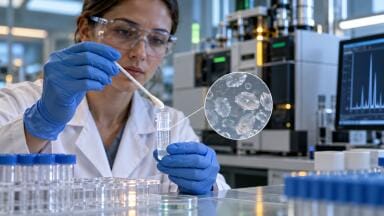
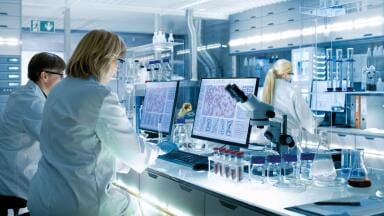
The Imperial researchers working in the new labs are developing a deeper understanding of what happens to these emissions at the microscopic level by carrying out experiments to observe CO2 within the rock under reservoir conditions and modelling how it flows through tiny pores in the rock. This is then linked to imaging experiments and models on a larger scale, so that the researchers can predict what happens to CO2 when it is stored in carbonate rock reservoirs, which can be hundreds of kilometres in size.
Combined, these models will give the researchers unprecedented detail about how to store CO2 efficiently and effectively in carbonate rock.
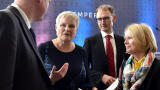
The research is part of the Qatar Carbonates and Carbon Storage Research Centre (QCCSRC), which was established in 2008 as part of a 10-year, $US 70 million collaboration between Imperial, Qatar Petroleum, Shell and Qatar Science and Technology Park. The laboratories were officially opened by Mr Saad Al-Kaabi, Director of Oil and Gas Ventures for Qatar Petroleum, Mr Peter Voser, Chief Executive Officer of Shell, and Dr Tidu Maini, Executive Chairman of the Qatar Science and Technology Park.
ILM 51.6 Sept 2026


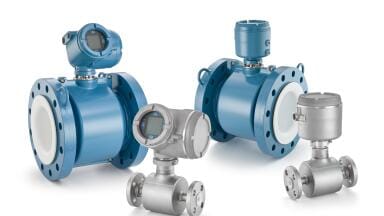
 Product directory













.jpg)
,-photo-Karin-Allander.jpg)


.jpg)