Temperature control and sterilising
Published over 3 years ago. See the latest and most current information on Temperature control and sterilising.
Molecular distillation, also called high vacuum wiped film, thin film or short path distillation, is a well-known process to separate thermally sensitive material. Combined in a new unique construction with precise temperature control units, this allows high performance distillation for many different applications and products.
The main concept of short path distillation is to prevent breakdown or cracking by minimising residence time and thus thermal stress. This is achieved by letting the product pass through a heated tube where wipers distribute the material and create a thin film for enhanced evaporation. Additionally, thermal stress is reduced by lowering the boiling point of the product (i.e. by applying vacuum).
Molecular distillation is a special form of short path distillation where the pressure is reduced even further, typically to less than 1x10⁻² mbar. Through this, the mean free path of any molecule leaving the evaporator is longer than the distance between evaporator and condenser. That way all back-pressure (like in a conventional distillation column) is eliminated. Now the boiling point is no longer dependent on the vapour pressure but only on the molecular weight.
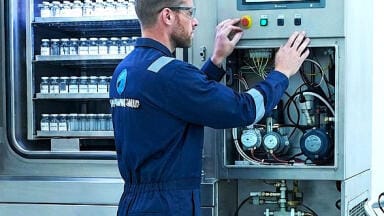
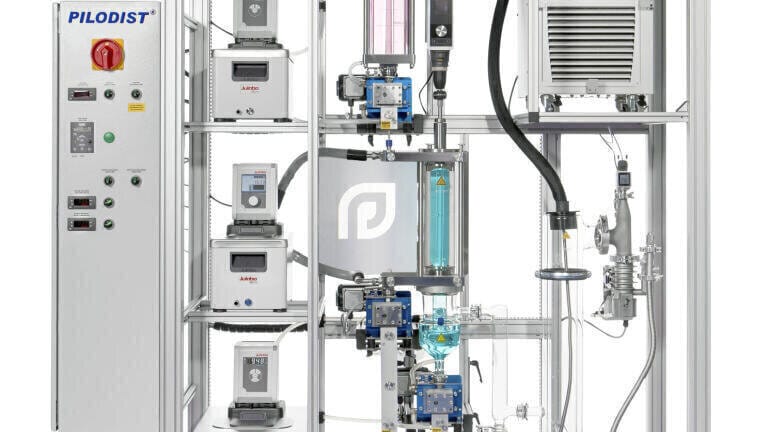
The SP 1000 CC from Pilodist GmbH is a turnkey system for laboratory use and small scale production. It is optimised to cover a wide range of applications, from high melting to high boiling points and can handle thermally sensitive material with full flexibility and completely continuous operation.
The SP 1000 CC is equipped with a unique and patented hybrid evaporator which combines all positive aspects of glass and stainless steel in one instrument. It is reliable and solid like stainless steel, but with the full visibility of a glass still. All metal parts are fully milled and turned out of solid blocks to prevent the risk of inaccuracy and corrosion like in welded constructions. The vertical concentric glass cylinders are bedded in flexible sealings to compensate thermal expansions and make the instrument safer and stronger than any other glass evaporator on the market. Due to its electro polished inner and outer surfaces as well as the full accessibility to all channels and bores, it is optimised for GMP-applications in the food & pharma industries.
With its complete heated inlet and outlet lines in combination with tempered feed and discharge pumps, melting points >150°C can be easily handled. The sophisticated vacuum system with its dry running chemical resistant scroll pump is able to handle incondensable volatiles. The 2nd stage air cooled diffusion pump can reach a system pressure down to 1x10⁻⁵ mbar.
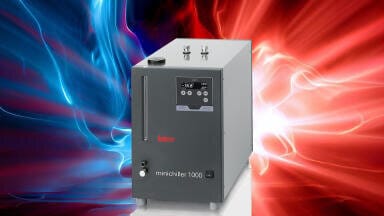
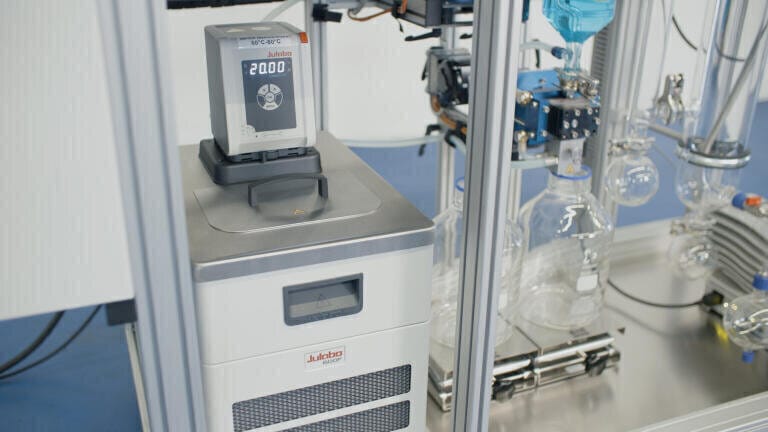
For optimal results it is crucial to have precise control over vacuum and temperature. For this, the SP 1000 CC uses individual temperature control units for all heating and cooling circuits. The feed vessel, tempered with a Julabo heating circulator, can pre-heat product to tailor its viscosity for ideal flow. The evaporator is also operated with a Julabo heating circulator for optimal heat transfer with a high circulation speed while the condenser uses a Julabo refrigerated circulator to collect and cool down the distillate. In addition, the condensation trap for collecting the very light volatiles is cooled with an Julabo immersion cooler down to -90°C.
All components are ideally aligned to each other, allowing for high automation and easy control for the user at the control cabinet.
More information online
ILM 51.6 Sept 2026




 Product directory