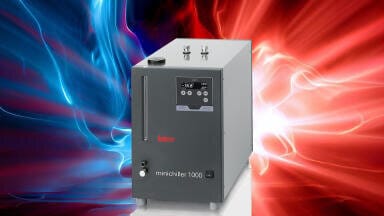
The Julabo Labortechnik GmbH HighTech series offers a new refrigerated circulator with innovative state-of-the art technology for more complex demands.
The model FP51-SL includes a self-optimising ICC (Intelligent Cascade Control) temperature control with temperature stability up to ±0.01 °C. The unit provide direct temperature measurement and control of the external system via an Pt100 sensor connection. The integrated early warning system for low liquid level (DBGM: 203 06 059.8) gives a warning, before a safety cut-off comes into effect. The circulator provides a powerful circulation pump system with electronically adjustable pump capacity (1.1 bar / 22-26 l/min).
The FP51-SL has a working temperature range of -51°C...+200°C and offers a cooling power of 2kW at +20°C in combination with 3kW heating power. Using the optional HST booster heater, the heating power can be increased by 6kW to a total of 9KW. An integrated programmer, with 6 x 60 program steps and a real-time clock, enables time-controlled temperature processes. Further features are 3-point calibration, large VFD-Display, Stakei connectors for solenoid valve and RS232/RS485 interface - analog interfaces (scalable) are available as option.




 Product directory