Temperature control and sterilising
Rotary evaporation is a dynamic, closed process. Heat and cooling flows, pressure, and motion continuously interact. The performance of a rotary evaporator cannot be enhanced by rotation alone. Decisive is the precise control of temperature within the overall system.
Thermal energy is introduced into the system via the heating bath through convective heat transfer. In most applications, water serves as the temperature control medium. For higher temperature requirements, silicone oils are used. Regardless of the medium, the stability of temperature control significantly determines process quality. Even minor deviations can disturb the thermodynamic equilibrium and destabilise evaporation.
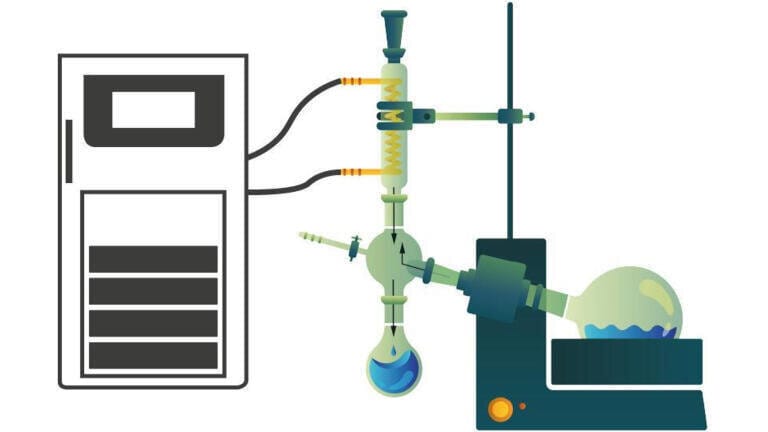
The energy required to transfer the solvent from the liquid to the vapour phase (enthalpy of vaporisation) is stored in the vapour and removed from the system during condensation. A stable vacuum ensures uniform heat and mass transfer toward the condenser.
Within the condenser, the thermal energy contained in the vapour is transferred to a cooling medium, causing the solvent to liquefy. The efficiency of this phase transition depends primarily on the temperature difference between vapour and cooling medium. Only within an optimal temperature window does condensation proceed completely and energy-efficiently.
Heating bath and condenser represent the two thermal poles of the rotary evaporator’s closed-loop system. Temperature, pressure, and flow must be continuously monitored and coordinated to ensure that energy input and removal remain balanced. While the heating bath initiates evaporation, cooling capacity determines whether the process remains stable, reproducible, and sustainable. The cooling system is therefore not merely a passive heat sink but an active control component within the thermal cycle of rotary evaporation.
The formerly common practice of cooling with tap water is now considered outdated. Fluctuating water temperatures, lack of controllability, and high resource consumption result in unstable processes and conflict with modern requirements for efficiency and sustainability. For this reason, recirculating coolers represent the current state of the art in rotary evaporation.
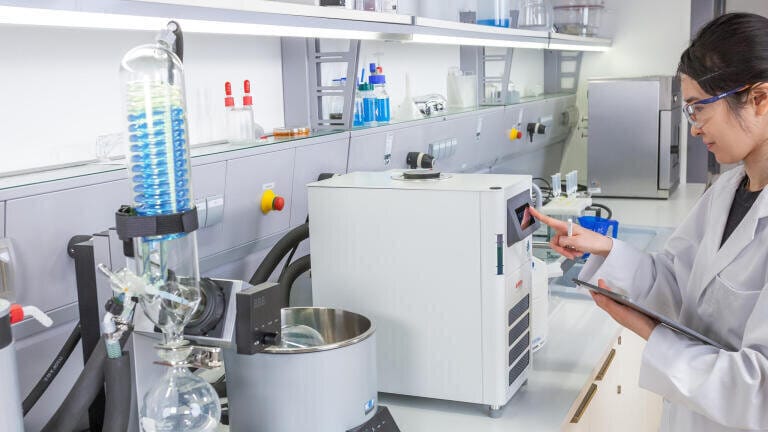
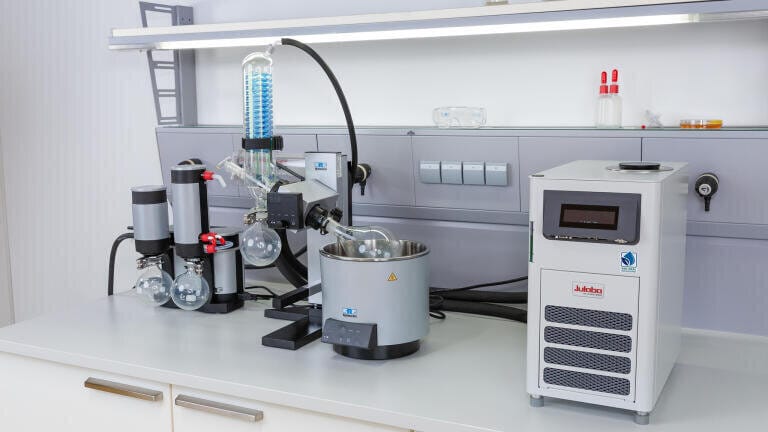
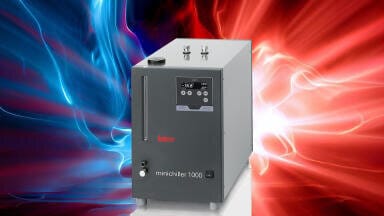
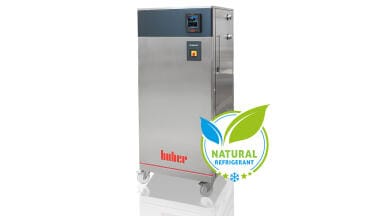
As a central component of modern rotary evaporator systems, the recirculating cooler ensures precise temperature control of the condenser and stabilises the entire thermal cycle. It operates actively within a closed system, electronically regulates temperature, and provides constant cooling performance – even under varying ambient conditions or fluctuating vapour loads. This creates reproducible process conditions while simultaneously reducing water and energy consumption.
The refrigeration circuit of a recirculating chiller is based on the principle of a refrigeration system that absorbs heat from a process medium (water, water–glycol mixture, or oil) and dissipates it to the surroundings. It is a closed-loop system that enables a constant temperature of the external device to be cooled (e.g., laboratory equipment, lasers). The cooled medium is pumped through the condenser of the rotary evaporator, where it absorbs the energy released during condensation, and is subsequently returned to the cooler. The circuit operates in a self-regulating manner and independently of external supply conditions.
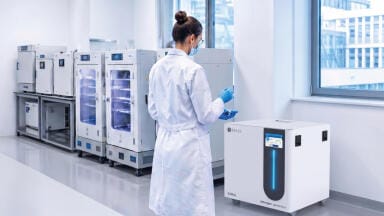
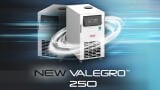
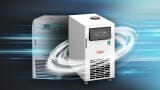
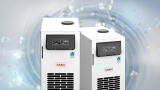
The high control accuracy of modern recirculating coolers such as the VALEGRO from JULABO ensures complete and uniform condensation of solvent vapours. In this way, sensitive substances are protected, vapour losses are prevented, the vacuum pump is relieved, and process safety is ensured.
ILM 51.6 Sept 2026



 Product directory
















.jpg)
