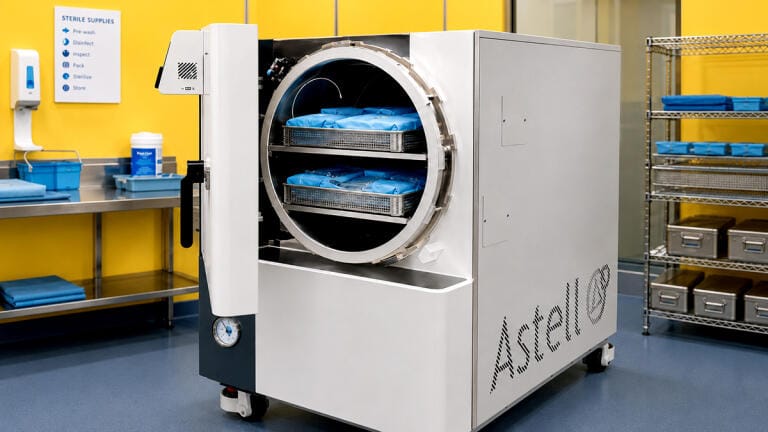
Autoclaves
In certain clinical or laboratory settings, “sterile” can carry an easily overlooked second requirement: dry. A wrapped instrument set that emerges from the chamber damp is not ready for use – moisture is a route back to contamination the moment the pack leaves the machine. Sterilising wrapped and porous loads therefore demands more of an autoclave than sterilising a bottle of media ever does.
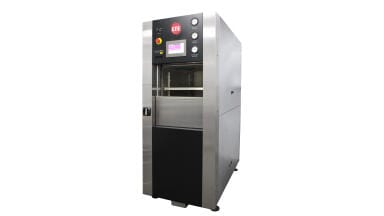
Wrapped instruments, textiles and other porous materials need a vacuum steriliser: one that pulls air out of the chamber before the cycle begins, so steam can reach every surface inside a tightly wrapped set rather than being blocked by trapped air pockets. At the end of the cycle, the same principle works in reverse, drawing steam back out so it cannot condense inside the pack as it cools.
But vacuum only gets a load sterile – it does not get it dry. That is a separate job, and it needs two more pieces of equipment working alongside it.
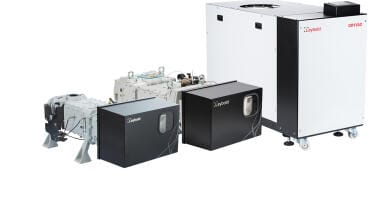
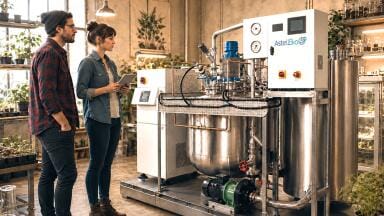
To finish drying a load, the chamber itself needs to be warm. A heating jacket fitted around the chamber drives off residual moisture using dry heat, rather than adding any moisture of its own. That jacket, in turn, needs a steam supply to heat it – either generated by the machine itself or fed in from the site's own steam supply.
Vacuum, heating jacket and steam generation function as a set. Remove any one of the three and packs stop coming out reliably dry, however well the sterilisation stage itself performed. This is also why a vacuum steriliser is a distinct class of machine from the simpler, chamber-heated autoclaves used for glassware and fluids – it needs specifying deliberately from the outset, not retrofitted once a problem shows up on the bench.
Labs running a vacuum steriliser still need the everyday jobs covered: glassware, occasional fluid loads, and safe decontamination of contaminated waste before disposal. In most instances a fully equipped vacuum unit is more than capable of handling these load types, with modern autoclaves equipped with automated cycles for different load types as standard. When throughput is more than one autoclave can handle, it is worth assessing load types and establishing whether a simpler autoclave can handle the simpler loads like glassware, while the jacketed, vacuum-equipped autoclave handles the more complex load types.
A typical cycle for wrapped instruments runs at 134°C for a short hold of around three minutes, with pre- and post-cycle vacuum stages and a heated drying period built in. Contaminated waste, by contrast, is usually taken through a separate discard cycle at 121°C or above, on its own programme rather than sharing a cycle with clean loads.
For anyone specifying or troubleshooting this kind of equipment, the deciding factors are dry, reliably sterile packs at the end of the cycle, and a cycle record robust enough to be relied upon. Where instrument sterilisation supports clinical or laboratory work, the paperwork proving a load was processed correctly is as much a part of the job as the sterilisation itself – and it starts with recognising that “sterile” and “dry” are two separate outcomes, each needing its own piece of engineering to deliver it.
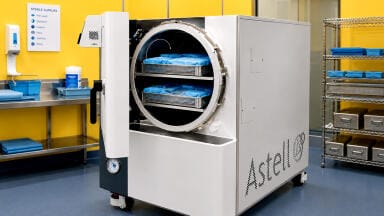
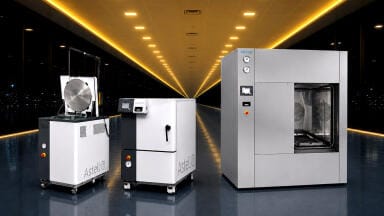
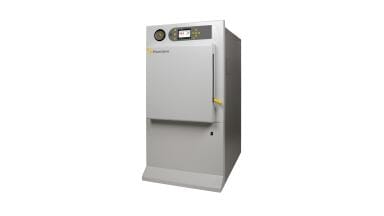
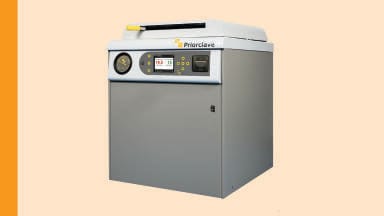
Astell has manufactured autoclaves since 1884, with over 140 years of expertise in matching machines and options to laboratory workflows. Astell autoclaves can be equipped with a variety of options across their model range, with top-loading, front-loading, and square-chambered autoclaves able to be customised with a variety of options including vacuum, heating jacket and steam generators needed to dry wrapped and porous loads reliably. Astell would be glad to help you specify the right configuration for your lab. Contact the team to discuss your requirements.
ILM 51.6 Sept 2026


 Product directory


.jpg)
.jpg)














.jpg)
