Autoclaves
When Astell Scientific brought its effluent decontamination work together under the AstellBio brand, the thinking behind it had already been tested in the field. One of the earliest projects to point the way was a system supplied to a UK plant-science facility — a job that began as a single line in a building tender and ended as a working argument for treating effluent decontamination as a discipline in its own right.
The customer was establishing a new contained-use production facility, using plants themselves as the production system to grow biological products. Because the site handled genetically modified micro-organisms under containment, the liquid waste it produced could not simply go to drain. It had to be rendered safe first — thermally, on site, and in a way that could be proven every time before anything was released.
That requirement is what brought Astell in. In 2015–16, while a new building was taking shape with a main contractor appointed and the customer's project team coordinating the specialist equipment, the facility needed a way to decontaminate its wastewater automatically and verifiably before any of it entered the public drainage system.
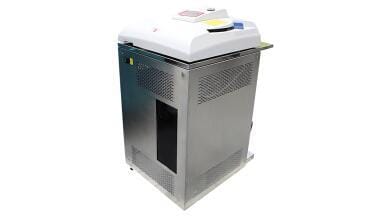
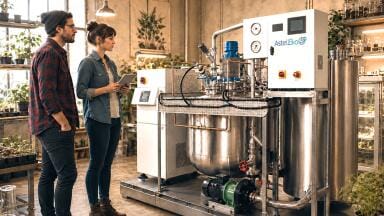
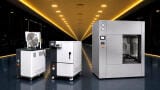
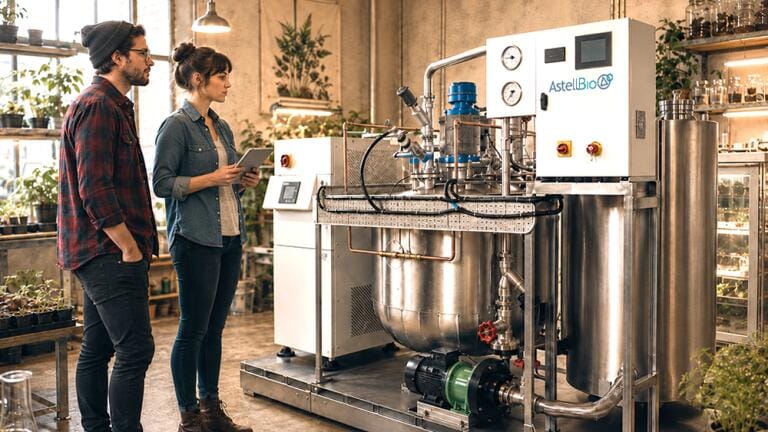
The answer was an EFF350H batch effluent decontamination system. It held roughly two days' worth of effluent, so production was never gated by the treatment cycle, and it proved, every cycle, that sterilisation conditions had been met before allowing discharge. Its in-service cycle held each batch at a minimum of 121 °C and 15 psi for 20 minutes, but the controller was multi-program and the plant could run either of two temperature-and-time combinations to suit the load — the 121 °C / 20-minute cycle used here, or a higher-temperature, shorter-hold alternative in the region of 135 °C for around two minutes. Because it installed outdoors on a plinth, it had to be designed for weather and frost protection from the outset.
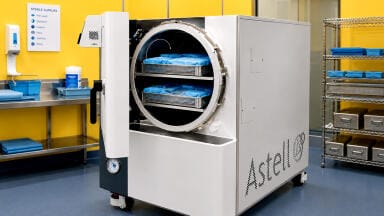
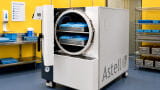
It was also procured the hard way — specified into a live main-contractor tender rather than sold across a desk. In practice that meant quoting both the client and the contractor's estimating team in parallel, to make sure the system was carried correctly through into the build. Astell autoclaves were supplied to the same facility to handle solid waste; the effluent system dealt with the liquid stream — the part of containment that is easiest to overlook and hardest to retrofit.
Looking back, what stands out is how much of the later AstellBio approach was already present here: a bespoke system sized to the customer's throughput, cycle-by-cycle verification before discharge, and an installation engineered for a real building rather than an ideal one. It was one of the first projects of its kind for Astell — and a useful reminder that the hardest part of effluent decontamination is rarely the heat. It is proving, every time, that the waste is safe before it leaves the building.
ILM 51.6 Sept 2026



 Product directory