Laboratory products
Plasmid DNA has become an essential element of advanced biomanufacturing for a wide range of applications, including transformation, transfection, sequencing and molecular cloning. The use of plasmid DNA in cell and gene therapies is growing because it enables safe, flexible and scalable solutions. Plasmids are also widely used in vaccine development due to their ability to deliver substantial amounts of DNA with a lower risk of oncogenesis and immunogenicity, especially when compared to viral vectors. It’s no wonder, then, that the market for plasmid DNA manufacturing is forecast to grow more than 18.52% a year to reach $9.29 billion by 2033 [1].
However, this rapid growth also poses significant challenges for scientists and technology developers in the biopharmaceutical industry. Conventional plasmid DNA extraction and purification methods are often labour intensive, time consuming, and prone to variability, which creates bottlenecks and limit scalability or consistency in biomanufacturing workflows.
Automating key stages of the plasmid DNA purification workflow offers a powerful opportunity to enhance both consistency and efficiency. While adopting automation inevitably involves a learning curve for researchers accustomed to manual procedures, the long-term benefits are greater productivity, improved reproducibility and reduced operational costs, making the transition well worth the effort.
The initial step in plasmid extraction involves alkaline or enzymatic lysis of bacterial cells, which disrupts the cell envelope and releases plasmid DNA into the lysate. This is followed by chemical neutralisation and phase separation to remove genomic DNA and cellular byproducts, with subsequent purification steps to isolate plasmid DNA at a high purity. This workflow often results in variable plasmid yields, and there is a significant risk of endotoxin contamination from bacterial cell components. Reducing endotoxin carryover during the isolation process is technically challenging and requires careful control of lysis and purification conditions. All these issues present obstacles when it comes time to scale up the production of plasmid DNA.
Reliance on manual workflows exacerbates process variability. A typical 96-well plasmid extraction run may involve dozens of sequential liquid transfers, wash steps and plate manipulations. Despite the use of multichannel pipetting, numerous manual touchpoints remain, increasing susceptibility to volumetric inaccuracies, aerosol generation, and contamination events. These factors contribute to inconsistent yields and reduced reproducibility across batches.
To investigate the potential benefits of automation, Beckman Coulter Life Sciences teamed up with oncology and rare disease drug developer Recursion Pharmaceuticals to develop and test an optimised protocol for plasmid DNA production. Recursion used automation to optimise the suspension, filtration and buffering processes. The aim here was to establish a scalable plasmid preparation process yielding 10 or more mg of plasmid DNA at high purity, suitable for applications such as transient transfection and recombinant protein expression, with reduced inter-batch variation and substantially lower hands-on time than conventional manual workflows.
This work has provided a practical framework that biopharmaceutical teams can use to implement automation strategies for scalable plasmid DNA production.
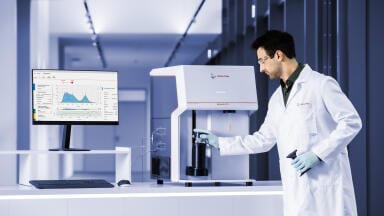
To improve the efficiency of the purification process, Recursion deployed a workflow using a liquid handler and a centrifuge to prepare high-throughput plasmid DNA from E.coli cells. The process involves a filtration method that separates flocculates from the plasmid DNA. This eliminates the need for lengthy centrifugation, which is widely used to push flocculates to the bottom of the mixture, leaving plasmids floating on top. Although centrifugation does work, it may be prone to contamination due to colloidal dispersion of pelleted debris if not completed rapidly or precisely.
After the lysate is clarified with a filter plate, the DNA binding and washing is performed using an optimised method that utilises SPRI magnetic bead separation technology to purify plasmid DNA from contaminants. The study led by the scientists at Recursion compared the purified plasmid DNA yields from 4 different type of vectors, which were prepped by using a magnetic bead-based SPRI technique, and these preps consistently yielded 12 milligrams or more of plasmid DNA at high levels of purity [2].
The Recursion study also investigated the potential of further improving purity by applying an endotoxin removal solution after neutralising the lysis. This resulted in reduced yields without significantly lessening endotoxin levels. The researchers demonstrated that the magnetic bead-based SPRI technique produced consistent high yield of plasmid DNA at purity levels that are comparable to what can be achieved with other manual techniques. It suggests the use of endotoxin removal solutions is unnecessary in an automated magnetic bead-based SPRI technique, as the purified plasmid DNA is already very low in endotoxin levels. This was verified by two approaches; firstly, the endotoxin levels were detected across a representative selection of preps where the endotoxin concentrations were estimated as Endotoxin Units/microgram (EU/µg). The second approach was entailed by transfecting the purified plasmids into Expi293 cells using FACS and then measuring the efficiency of these transactions with a CytoFLEX flow cytometer [2].
Another important step in the optimised plasmid DNA workflow is the use of Tris-EDTA (TE) buffer as eluent to improve transfection efficiency. In the Recursion study, TE was compared to two other buffers: pure water and a commercial elution buffer. TE, which has a pH level of 7.5, was highly efficient, with 90% of the cell population expressing a positive transfection marker. By contrast, less than 45% of cells eluted by water (pH 4) or the commercial buffer (pH greater than 9) expressed positive transfection markers. [2]
This result shows that the pH value of the buffer is a key consideration when eluting plasmids. Using a buffer with a pH value around 7.5 results in a stable product ideal for downstream applications such as transfections, DNA editing, and sequencing.
This collaboration demonstrated that automating much of the plasmid DNA workflow reduced hands-on time from 57 minutes to 15 minutes for batch sizes of four, 24 and 96 samples – a 74% reduction [2]. It’s easy to see how that could translate into significant cost savings. Imagine a lab that has 10 scientists working on different plasmid DNA workflows. The ability to complete those projects in 74% less time boosts the cost-effectiveness of those projects through increased productivity. By transferring the most repetitive and error-prone pipetting steps to automated liquid handling, the workflow reduces variability and supports scientists in generating more consistent results, while freeing time for higher-value analytical and decision-making tasks.
Embracing automation may be daunting, particularly for scientists who do not have the programming skills necessary to set up automated workflows. The good news is that as automation becomes more mainstream, many young scientists are getting up to speed and learning programming techniques that will help ease the transition from manual to automated processes. As the demand for plasmid DNA continues to rise, the benefits of automated solutions will flow to benefit the healthcare industry to support patients, as well as accelerating the development of novel vaccines, cell therapies and gene therapies.
1. Grand View Research. Plasmid DNA Manufacturing Market (2026 - 2033). Available at: https://www.grandviewresearch.com/industry-analysis/plasmid-dna-manufacturing-market-report (accessed March 16, 2026).
2. Beckman Coulter Life Sciences. Whitepaper. Enhanced automated DNA purification with the CosMCPrep
Kit on a Biomek i7 Workstation. Available at: https://share.google/yDxm2LK8qrUebHubw (accessed October 15, 2025).
ILM 51.6 Sept 2026



 Product directory












.jpg)
.jpg)

.jpg)


.jpg)
