Columns
Published over 12 years ago. See the latest and most current information on Columns.
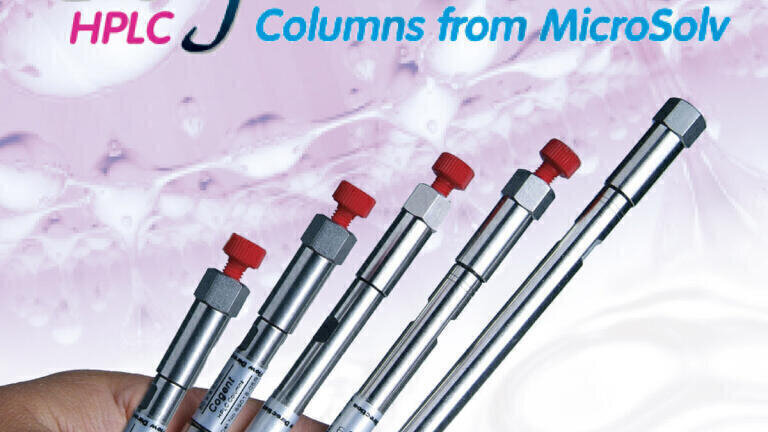
Cogent Diol is a 4um diol bonded phase suitable for the reversed-phase or aqueous normal-phase (ANP) analysis of polar compounds and is LC-MS compatible. Columns show fast equilibration between gradient runs and can be successfully used in studies of pathways in human pathology.
Cogent UDA is a new unique selectivity phase where the silica hydride surface is bonded with an eleven carbon chain terminating in a carboxylic acid (undecanoic acid), giving the phase weak cation-exchange properties in addition to aqueous normal-phase (ANP). All the features and benefits of TYPE-C Silica, such as fast equilibration, precision, multi-mode and robust column-lifetime are maintained. The Cogent UDA columns have applications in metabolomics and have been used for the analysis of nucleotides.
Cogent Diol and Cogent UDA (undecanoic acid) are the latest additions to the MicroSolv range of stationary phases for high performance liquid chromatography (HPLC). Both columns are based on MicroSolv’s unique TYPE-C Silica and silica hydride surface chemistry.
For further information contact Hichrom Limited, tel: 0118 930 3660 or click here.
ILM 51.6 Sept 2026





 Product directory