![Table 1: Analytes and internal standards list for PFAC-MXC and MPFAC-C-ES [1].](/assets/file_store/pr_files/66971/thumbnails/images/768w-432h-t-fit-1Table.jpg)
Columns
Per- and polyfluoroalkyl substances (PFAS), including perfluorooctanesulfonic acid (PFOS), are persistent fluorinated compounds that can accumulate in the environment and enter the food chain. LC-MS/MS is widely used for PFOS determination, but accurate analysis in food matrices can be complicated by interfering compounds. Based on the work of Takayama et al. [1], a new Application Note shows how the YMC Accura Triart C18 column with a (bio)inert coating enables selective PFOS analysis.
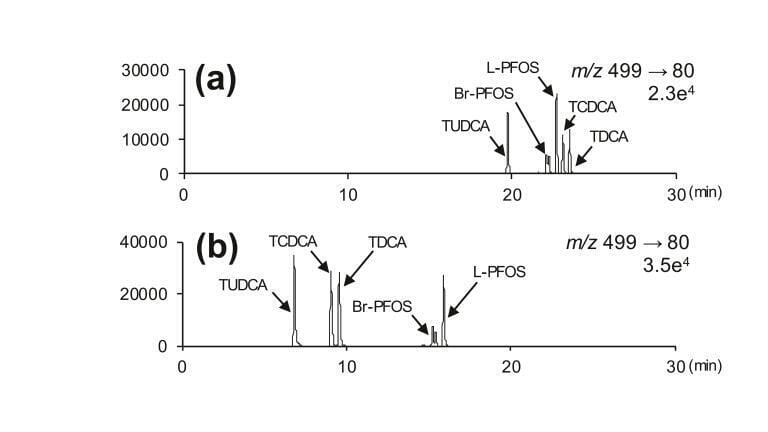
Interferences mainly arise from bile acid–related substances, especially taurocholic acid isomers present in animal-derived foods such as meat, fish and eggs. In negative electrospray ionisation mode these compounds produce the same SRM transition as PFOS (m/z 499 → 80). If chromatographic resolution is insufficient, this overlap may result in false positive signals.
During method optimisation, the mobile phase composition proved critical. Methanol-based conditions caused PFOS to co-elute with several taurocholic acid isomers, including TUDCA, TCDCA and TDCA. Replacing methanol with acetonitrile significantly improved selectivity and enabled complete separation of PFOS from these compounds (Figure 1).
Using the optimised LC-MS/MS conditions, 21 PFAS compounds were successfully separated (Table 1). Short- and mid-chain PFAS (C4–C9) showed sharp peaks and strong signal responses, enabling sensitive quantification. Recovery experiments in spiked food samples (0.1 and 1 ng/g) yielded 80–120 % recoveries with relative standard deviations below 15 %. Endogenous bile acid compounds eluted well before PFOS, confirming effective separation from potential interferences.
The methanol-free LC-MS/MS method combined with the (bio)inert YMC Accura Triart C18 column enables reliable PFOS determination and robust PFAS analysis in complex food matrices.
More information online
ILM 51.6 Sept 2026


 Product directory


.jpg)