Company news
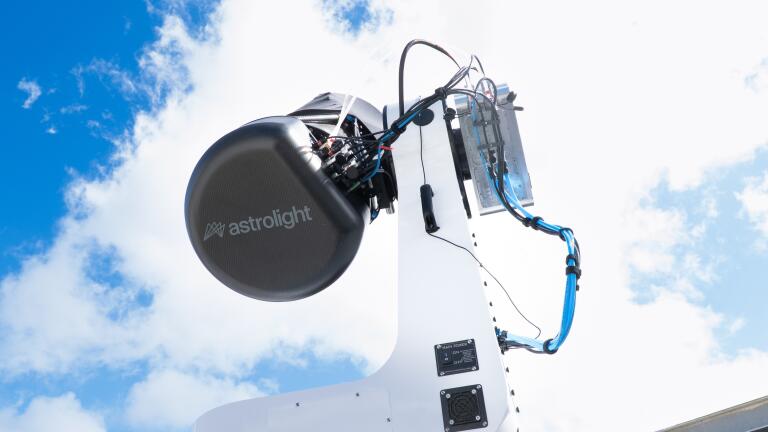
Europe’s push to relieve pressure on crowded radio spectrum has taken a step forward with the commissioning of a new laser communications ground station in Greece, designed to test high-speed, secure satellite-to-Earth data links.
Lithuanian space company Astrolight has completed work on the Holomondas Optical Ground Station, developed with Aristotle University of Thessaloniki and supported by the European Space Agency (ESA) and the Greek Ministry of Digital Governance. The facility is now supporting in-orbit demonstration missions using CubeSats carrying optical communications payloads.
The station is part of ESA’s Greek Connectivity Programme and will be used to validate end-to-end laser communication links between space and ground, alongside Astrolight’s onboard laser terminals deployed on the PeakSat and ERMIS-3 satellites, which recently reached orbit.
Unlike traditional radio frequency systems, optical links use narrow beams of light to transmit data at much higher speeds and with greater resistance to interference and jamming, making them increasingly attractive for secure space communications.
ESA said the project marks “an important step towards enabling faster, more secure and resilient connectivity”, as part of efforts to strengthen Europe’s optical communications capability.
Astrolight CEO Laurynas Mačiulis said the project demonstrates the value of integrated space and ground systems: “By designing both segments together, we were able to streamline the path from integration to in-orbit testing.”
The new facility is expected to contribute to a wider European network of optical ground stations as demand grows for higher-capacity satellite communications.
More information online
ILM 51.6 Sept 2026



 Product directory
























.jpg)
