DNA / RNA
Published over 15 years ago. See the latest and most current information on DNA / RNA.
Scientists from Imperial College London have used data collected at Diamond Light Source to advance the understanding of how HIV and other retroviruses infect human or animal cells. Using Diamond’s finely tuned pinpoint X-ray beams the researchers were able to determine 3D structures of the key molecular machine used by viruses, such as HIV, to insert copies of their genetic material into host DNA. This fundamental knowledge will not only facilitate design of better drugs for fighting AIDS, but may also have an impact on pioneering treatments such as gene therapy; an experimental technique using tamed versions of viruses to treat genetic disorders.
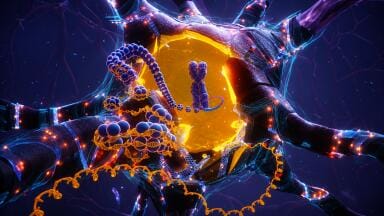
HIV and other retroviruses carry their genetic material as RNA. After entering a human or animal cell, they convert their genomic RNA into DNA, which is then inserted into a cellular chromosome. To accomplish this, retroviruses use integrase, an enzyme that brings the ends of the viral DNA and cellular DNA together. It then irreversibly joins the DNAs, making the infected cell a permanent carrier of the viral genome.
In early 2010 the researchers announced the initial breakthrough, when they determined the structure of integrase from the prototype foamy virus (PFV) assembled on viral DNA ends. Crucially, because PFV is very similar to HIV in the way it integrates its DNA, the structures allowed them to explain how an important class of HIV drugs disable integrase. Now the group has determined 3D structures of PFV integrase bound to both viral and cellular DNA. These new structures elucidate how integrase attacks cellular DNA and the mechanics of irreversible insertion of viral DNA.
These findings may enable improvements in gene therapy to correct gene malfunctions. A disabled version of a retrovirus can be used to insert a functional copy of a gene into a human chromosome. Although such approaches have proven quite successful, they are still experimental, requiring more work to make them safer. The structural data collection was carried out on the I02 macromolecular crystallography experimental station at the Diamond synchrotron in Oxfordshire.
ILM 51.6 Sept 2026





 Product directory















.jpg)
,-G.-von-de-Kerkhof-(Diamond),-M.-Schuster.jpg)