DNA / RNA
A new review explores how engineered exosomes could deliver personalised mRNA cancer vaccines to lymph nodes, turn immune-resistant ‘cold’ tumours ‘hot’ and improve responses to immunotherapy
Researchers reviewing the current evidence on cancer vaccine design have set out how engineered extracellular vesicles loaded with messenger RNA (mRNA) could overcome one of oncology’s persistent delivery problems: getting a therapeutic payload to lymphoid tissue without it being cleared by the liver or triggering unwanted systemic effects.
Synthetic lipid nanoparticles (LNPs), the current standard for delivering mRNA therapeutics, are prone to sequestration by the liver. This happens because blood-borne apolipoprotein E binds to the particles, which limits how much of the payload reaches tissue outside the liver. The review examines exosomes – naturally occurring, cell-derived vesicles – as a biological alternative that may sidestep this constraint.
Exosomes carry a native lipid bilayer rich in cholesterol and sphingomyelin, which protects mRNA cargo from degradation by ribonucleases. Their surface can also display markers such as CD47, a signal that blocks macrophage phagocytosis via the SIRPα receptor and extends circulation time in the bloodstream.
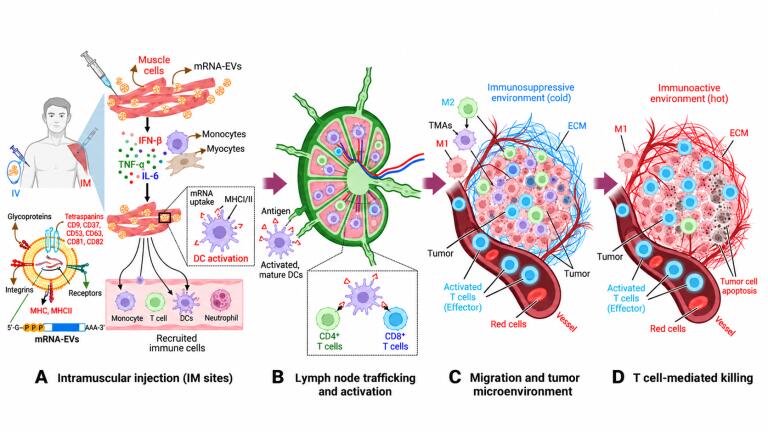
According to the review, mRNA-loaded exosomes delivered by intramuscular injection generate local inflammation at the injection site. This recruits host immune cells and triggers cytokine release governed by mRNA-mediated epigenetic regulation. The recruited cells then migrate to regional lymph nodes for further activation before trafficking into the tumour microenvironment, where the review states they can convert an immunologically ‘cold’ tumour into an inflamed, ‘hot’ one. Within this altered environment, cytotoxic CD8+ T cells and natural killer cells are reported to clear malignant tissue more effectively, and the tumour becomes more responsive to immune checkpoint inhibitors.
The review was authored by researchers at Case Western Reserve University School of Medicine, Cleveland, Ohio, USA, who set out a mechanistic case for pairing personalised tumour neoantigens with bioengineered extracellular vesicles to address resistance to existing immunotherapies.
While mRNA platforms have already demonstrated their value in antiviral vaccines, applying the same approach to solid tumours has proved more difficult because of local immune tolerance within malignant tissue. Tumours can exclude effector immune cells by building physical barriers in the extracellular matrix, altering local biochemical signalling and recruiting regulatory immune cell populations. The review argues that combining multivalent mRNA payloads with surface-engineered exosomes could help overcome these barriers.
A central theme of the review is that any long-term anti-tumour effect is sustained through epigenetic mechanisms rather than changes to the underlying genetic code. The cytokine environment generated by the vaccine is described as driving chromatin remodelling in both myeloid and lymphoid immune cell lineages – including increased H3K27ac at gene promoter regions and demethylation of the IFNG and GZMB gene promoters – which the authors link to trained innate immunity and expanded pools of memory T cells. This is intended to keep immune effector cells primed to respond rapidly if a tumour recurs.
The authors note that sustaining chromatin in this more accessible state requires careful timing, to avoid the risk of chronic inflammation or autoimmune activity against healthy tissue. They also identify manufacturing as a barrier to clinical translation and call for laboratory-scale ultracentrifugation to be replaced with cGMP-compliant tangential flow filtration and size-exclusion chromatography to better control vesicle uniformity at scale. The longer-term goal set out in the review is a pre-manufactured, modular exosome platform that can be rapidly loaded with a patient’s own neoantigen profile, making the approach viable as a scalable form of personalised medicine.
For further reading please visit: 10.1093/pcmedi/pbag019
ILM 51.6 Sept 2026



 Product directory


.jpg)
.jpg)


















.jpg)
