Electron
Published over 5 years ago. See the latest and most current information on Electron.
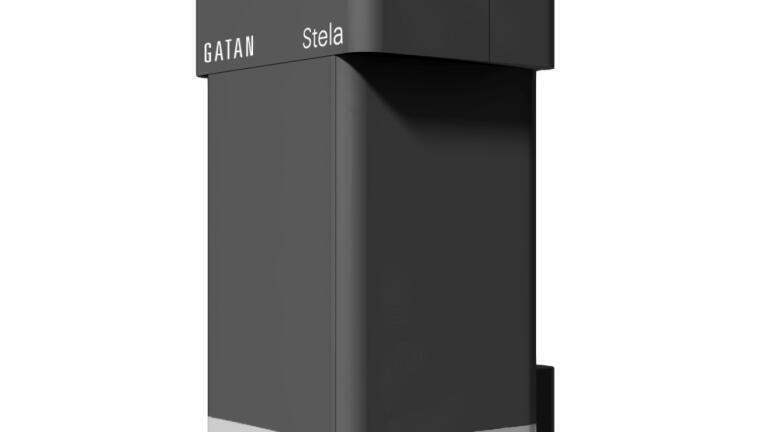
Gatan, a leading manufacturer of instrumentation and software used to enhance the performance of electron microscopes, and Dectris, the industry leader in hybrid-pixel X-ray and electron detectors for science and industry, have announced the signing of a joint sales and service agreement pertaining to the use of Dectris technology in Gatan’s new Stela™ camera.
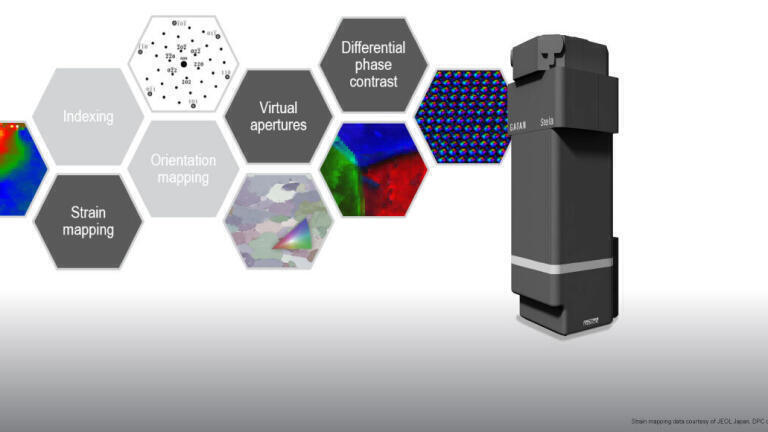
In the framework of this agreement, Gatan has fully integrated a Dectris hybrid-pixel electron detector within the Gatan Microscopy Suite® platform and now offers a complete workflow for advanced four-dimensional scanning transmission electron microscopy (4D STEM) diffraction. Known as the Stela camera, it will enable the mainstream adoption of the 4D STEM diffraction technique in electron microscopy labs around the world.
“Hybrid-pixel electron detectors by DECTRIS bring countless opportunities for materials science TEM and STEM applications, such as 4D STEM, from increased instrument throughput to reduced total cumulative electron dose,” stated Dr Christian Broennimann, Chief Executive Officer of Dectris. “The synergy between Gatan and Dectris will bring our technology to the thriving electron microscopy market.”
“I am very pleased by this agreement with Dectris, as their hybrid-pixel electron detectors truly complements our current portfolio and unified workflows within Gatan Microscopy Suite,” commented Narayan Vishwanathan, Vice President and Business Unit Manager of Gatan. “With this new camera, we are now able to offer our researchers complete, efficient workflows to perform advanced, high-speed, and high-quality 4D STEM diffraction studies.”
During the design and discovery of materials, researchers frequently use STEM to focus an electron probe (from a few nanometers to subatomic dimensions) onto the specimen to collect various signals as the electrons interact with and scatter from the sample. 4D STEM diffraction is an advanced technique in which the probe is rastered on the specimen in a two-dimensional (2D) array. At each probe position, a 2D diffraction pattern is imaged on a pixelated detector, thus generating a 4D data cube that can be further analysed.
A successful 4D STEM experiment primarily relies on robust and easy-to-use software for data acquisition and analysis, as well as high data quality and acquisition speed that is mainly dictated by the detector used to collect the diffraction patterns. This collaboration between Gatan and Dectris will bring all these aspects together in a single package that enables researchers at all levels to access this critical experimental method.
ILM 51.6 Sept 2026





 Product directory