Laboratory products
Published over 15 years ago. See the latest and most current information on Laboratory products.
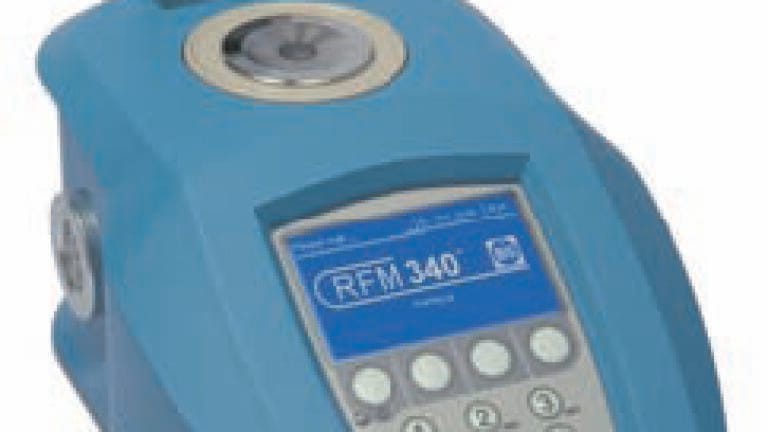
The RFM300+ Series of Peltier temperature controlled refractometers from Bellingham + Stanley has been adopted by many leading food and beverage manufacturers as the primary tool for controlling product yield and to assure end-point quality of finished goods.
Following improvement to the thermodynamic control system, the RFM340+ version now has an increased measurement performance between 0-20°Brix reducing potential measurement error in the critical range covering finished products such as sodas, fruit juice, beer, wine and cider. Improving the performance at the low end of the scale allows users to trim syrup dilution to the absolute minimum without the risk of breaching manufacturing specifications.
SG scales for sucrose are now common to the series. These scales may be used to express the relative density of pure sucrose solutions and when used in conjunction with a product offset from within the METHODS SYSTEM, can express finished beverages as an equivalent SG - just as if it were measured on a density meter. The instrument can also display both the °Brix and SG and by doing so, contract packers may now use a refractometer in situations where density °Brix or SG is dictated as the method of analysis, whilst retaining all the measurement advantages held by a refractometer.
ILM 51.6 Sept 2026



 Product directory