Laboratory products
Published over 16 years ago. See the latest and most current information on Laboratory products.
Recent polymer co-extrusion studies demonstrate the value of a unique die developed by Fleming Polymer Testing and Consultancy, for use with the Rosand capillary rheometer from Malvern Instruments. In combination the die and rheometer generate all the data needed to develop and validate co-extrusion process models, reducing the need for pilot scale studies. Small-scale experimentation coupled with process modelling gives detailed insight and reduces the time and expense associated with process optimisation.
Polymers are co-extruded to form composite products that exploit the properties of different materials. The development of successful co-extrusion systems demands careful control and matching of the constituent polymers, ideally at an early stage of the development process. Research shows that good rheological data allow highly effective simulation of co-extrusion processes, providing models for system optimisation. The Fleming PTC die exploits the design features of the Rosand rheometer to provide an integrated solution for the small-scale study of co-extrusion behaviour.
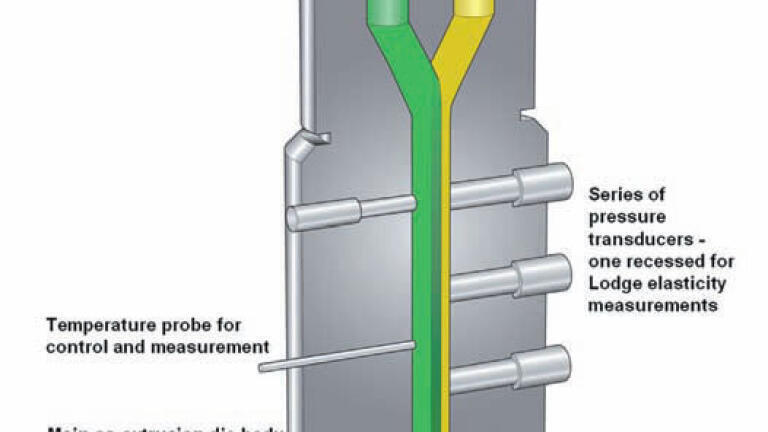
Accurate measurement of the pressure drop across the flow channel, at controlled polymer flow rates and temperature, produces the shear stress, shear rate and shear viscosity data needed for modelling.
The geometry of the die can be altered to manipulate shear rates using a series of inserts. The position of the resulting interface in a two-polymer system can be determined both by visual examination of the samples produced and prediction via flow simulation. In this way, the predicted interface position can be validated by practical observation together with assessment of the physical compatibility
of the two polymers being coextruded.
ILM 51.6 Sept 2026



 Product directory