Laboratory products
Published over 5 years ago. See the latest and most current information on Laboratory products.
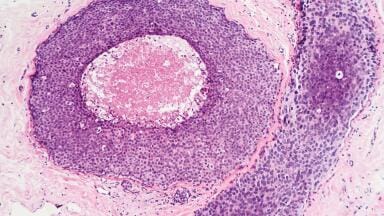
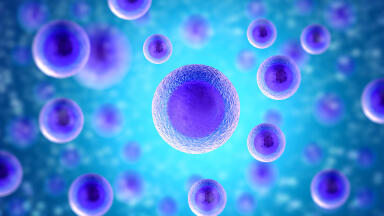
Three-dimensional (3D) cell culture is an attractive alternative to animal model research, and it is a predictive method for drug discovery and compound screening. By incorporating extracellular matrix (ECM) and other relevant factors, researchers design microenvironments in 3D cell culture that mirror those in vivo and provide the signals required for physiologically-relevant cell growth in vitro. These signals drive proper cell behaviour to extend proliferation time and closely simulate in vivo metabolic activity.
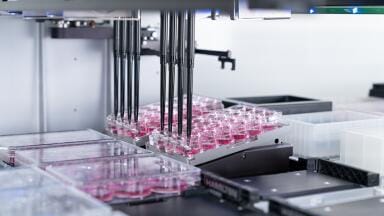
Using 3D cultures for drug discovery is particularly difficult because cell cultivation in 3D on a large scale, with automation, in a reproducible fashion, and at low cost is a challenge. To form 3D cell culture structures, researchers traditionally encapsulate cells in undefined Engelbreth-Holm-Swarm sarcoma-derived basement membrane extracts. These extracts are heterogenous hydrogels made of natural ECM proteins, such as various laminins and collagens, and growth factors, such as TFGβ, EGF, and IGF. The growth factors and ECM proteins are present at high levels that are not physiologically relevant, and the composition of each factor comprising a hydrogel can vary.
Synthetic ECM hydrogels are animal-free alternatives to natural hydrogels, their compositions are consistent and defined, which reduces batch-to-batch variability. However, most synthetic hydrogels still require additional steps to mix cells and hydrogels for encapsulation.
For high-throughput 3D cell culture, researchers must work with consistent and stable hydrogels that are simple to use.
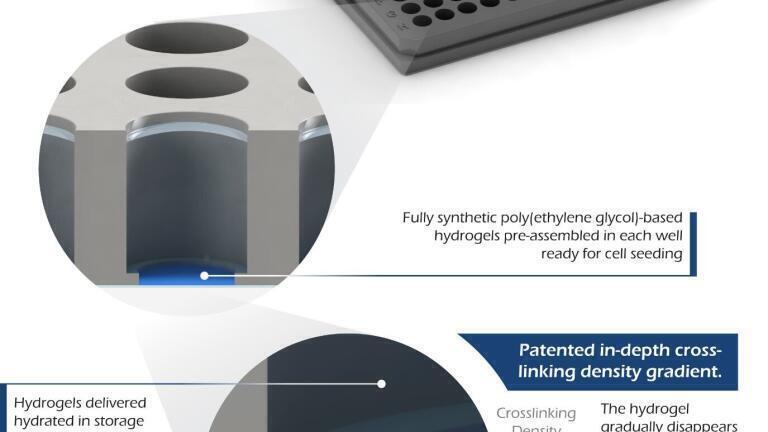
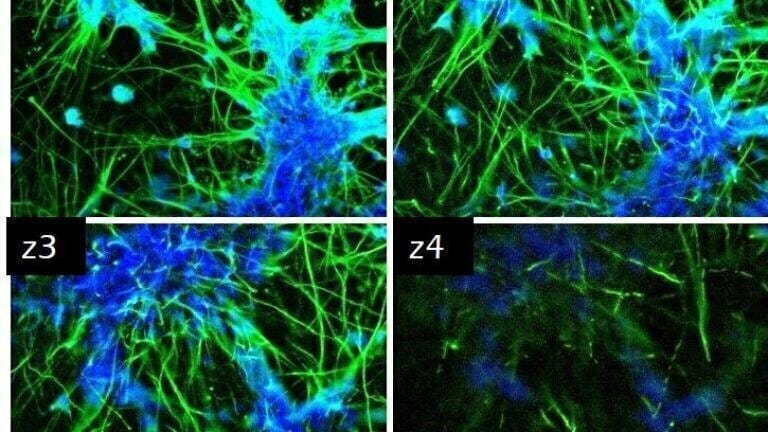
TrueGel3D®HTS Hydrogel Plates are ready-to-use 96-well polystyrene glass-bottom plates pre-cast with synthetic polyethylene glycol (PEG)-based hydrogels. These innovative hydrogels contain gradually increasing crosslinking densities throughout the well. Users can proceed directly with seeding cells without any hydrogel preparation or encapsulation steps. After cell seeding, cells will gradually infiltrate the hydrogel and establish a 3D cell culture environment within days. Furthermore, this newly engineered hydrogel surface gives the user the possibility to sequentially establish co-culture systems by seeding different cell populations at different time-points in the same hydrogel well.
In collaboration with The Scientist, we presented a Technique Talk where Dr. Nina Berges from Merck Serono demonstrated how to use convenient, automation-compatible, pre-cast hydrogel plates to quickly and easily establish 3D cell cultures for high-throughput screening and high content analysis.
Listen to the recorded Webinar on The Scientist.
ILM 51.6 Sept 2026



 Product directory


.jpg)









.jpg)