Laboratory products
Published over 8 years ago. See the latest and most current information on Laboratory products.
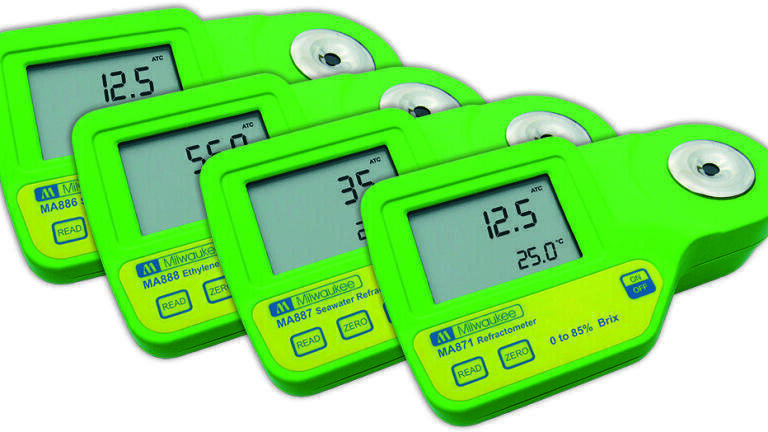
Digital refractometers are optical instruments that employ the measurement of refractive index to determine the % Brix of sugar, % Fructose, % Glucose, % Invert Sugar, sodium chloride concentration in aqueous solutions, salinity of seawater or % volume, and freezing point of ethylene glycol based coolants or antifreeze.
Measuring is simple and quick: samples are measured after a user calibration with deionised or distilled water; within seconds the instruments measure the refractive index of the sample, and convert it to the measurement units.
Digital refractometers from Milwaukee eliminate the uncertainty associated with analogue refractometers, and are easy to carry for measurements in the field.
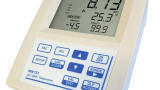
The measurement technique and temperature compensation employ methodology recommended in the ICUMSA Methods Book (Internationally recognised body for Sugar Analysis). Temperature (in °C or °F) is displayed simultaneously with the measurement on the large dual level display along with icons for Low Power and other helpful message codes.
Key features include: Dual-level LCD; Automatic Temperature Compensation (ATC); Easy setup and storage; Battery operation with Low Power indicator (BEPS); Automatically turns off after 3 minutes of non-use.
ILM 51.6 Sept 2026



 Product directory


.jpg)
.jpg)










.jpg)
.jpg)
.jpg)





.jpg)
