Laboratory products
Published over 15 years ago. See the latest and most current information on Laboratory products.
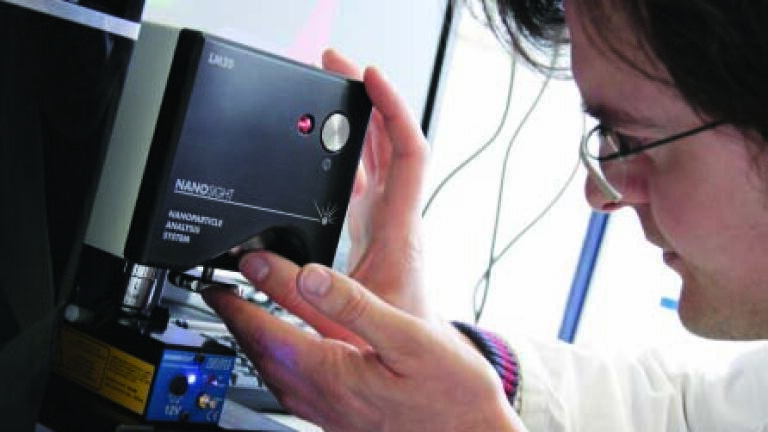
Coriolis PharmaServices GmbH is using NanoSight’s LM-20 nanoparticle characterisation system to investigate the aggregation behaviour of protein drugs and vaccines.
Coriolis is a contract research organisation for the formulation and analytics of pharmaceutical proteins and vaccines for their customers from national and international pharmaceutical companies. A special focus during formulation development is set on the characterisation of subvisible particles and aggregation. The main application requirement for the NanoSight system is to measure the number and the size distribution of aggregates in pharmaceutical protein formulations and of vaccines, e.g. virus-like particles. Protein aggregation is a major stability issue and can result in reduced biological activity and enhanced immunogenicity of the product. Therefore, it is important to analyse the aggregation behaviour of pharmaceutical proteins and develop methods and formulations that avoid aggregation already at the beginning of formulation development.
Coriolis uses a variety of instrumental techniques to quantify and size aggregates, depending on the size range of interest. Dynamic light scattering is ideal to analyse monodisperse systems, but once the aggregates start to form and grow, nanoparticle tracking analysis (NTA) from NanoSight gives a real distribution picture. For samples in the μm range, microflow imaging (MFI) and light obscuration are used.
In contrast to DLS, NTA works well with polydisperse samples giving an estimation of the total concentration of particles and the possibility to distinguish different size populations. This is not possible by DLS due to the poor resolution.
To achieve a comprehensive characterisation of nanoscale particulates in protein formulations, it is important to combine techniques that operate in that range. However, the ability of NTA to provide a real-time image of samples permits the analysis of potentially occurring difficulties during the measurement which is not possible using DLS.
ILM 51.6 Sept 2026




 Product directory