Laboratory products
Published over 15 years ago. See the latest and most current information on Laboratory products.
RheoSense, Inc announces the m-VROC. This analytical system for viscosity measurements has many advantages over conventional rotational and cone-and-plate viscometers, including accuracy, repeatability and ongoing cost effectiveness. Continuing to support market and scientific demands, RheoSense releases its new viscometer, m-VROC 2.5, enhanced for ease of use, greater accuracy and reproducible results.
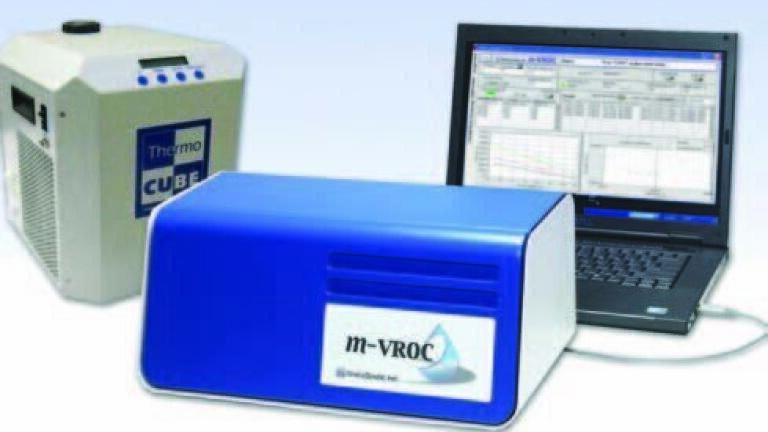
The m-VROC 2.5 is a complete measurement system, equipped with automatic chip recognition and closed-loop temperature control. The mechanical and electronic interfaces have been enhanced, making it even easier to capture, view and record viscosity measurements.This compact system is as portable as shown in the photo, easily transported from a laboratory to a production line for important, critical measurements. Cost-effective, the m-VROC provides accuracy with small sample volumes: 50 microliter, a significant factor when evaluating costly protein and other biological formulations.
With its wide measurement range (0.1 to 100k cP viscosity) and high shear rates, the m-VROC is capable of analysing virtually any liquid viscosity value, Newtonian and non-Newtonian Thermal characteristics are an important aspect of viscosity measurements - a change in temperature can affect viscosity, the accuracy and reliability of measurement results. An optional circulating water bath, a Peltier chiller, can be added for greater temperature control.
With this addition, the closed-loop temperature control system is fast and stable, operating at a range of 4ºC to 69ºC with the accuracy of +/- 0.05ºC.
The core of the system is VROC, the proprietary MEMS chip developed by RheoSense, Inc. To provide accurate measurement for a variety of liquid products, RheoSense supports that need with a selection of VROC chips. To help ensure the system is set up for optimum measurement, m-VROC 2.5 is equipped with automatic chip recognition.
ILM 51.6 Sept 2026



 Product directory