Laboratory products
Published over 13 years ago. See the latest and most current information on Laboratory products.
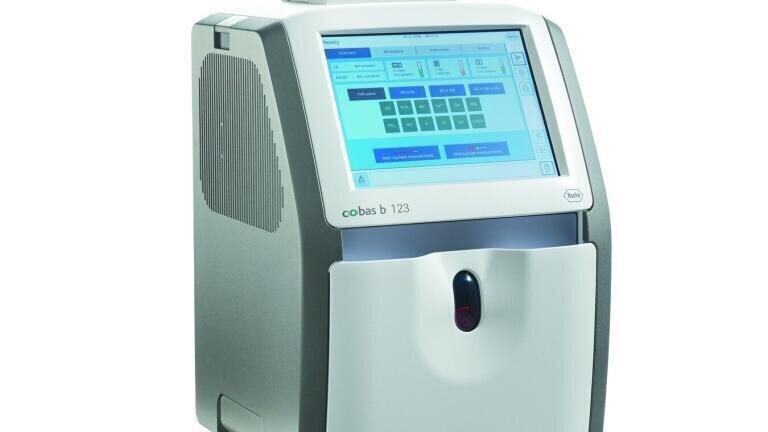
The excellent clot protection capabilities of the Roche cobas b 123 POC system have been highlighted in an evaluation undertaken in the intensive care unit (ICU) at Stepping Hill Hospital (Stockport NHS Foundation Trust).
175 patient samples were analysed throughout the evaluation, including approximately 30 samples that were considered ‘high risk’ for clotting. The tests were performed by nursing staff and quality control testing was performed automatically by AutoQC twice per day.
“We never had a problem with clots throughout the entire evaluation, despite using a wide variety of samples of varying condition and age,” said Samantha Ekin, Point of Care Co-ordinator at the Trust. “I can see that this will be vital in a delivery suite setting where the quality of samples can be lower. The small size of the analyser is great as it can be housed more easily and it is portable, if required.”
The analyser’s new clot clearance feature stops clots present in a sample moving from the syringe or capillary into the analyser. It does this using a dual-action pre-analytical barrier, with bottlenecks in the sample port needle and the co-oximetry measuring chamber, and any clots collected are simply rinsed away with the sample by the automated default washing routine. In-built optical sensors detect whether the lack of fluid path flow is due to a clot. If it is, the analyser performs a series of automated expulsion steps to remove the clot before continuing analysis uninterrupted.
To date, in both internal and external on-going evaluations, no downtime owing to clots has been reported for the cobas b 123. The system is also very easy to use and requires very little maintenance.
“The whole process of analysing a patient sample was very easy for the operator with minimal steps and easy on screen prompts,” Samantha Ekin continues. “This is very important, because if the nurses like the analyser, they will have confidence to use it and confidence in the results. The low maintenance is also extremely important, especially for ‘out of hours’ work, as it enables the operators to perform any maintenance that might be required.”
ILM 51.6 Sept 2026


 Product directory