Laboratory products
Published over 6 years ago. See the latest and most current information on Laboratory products.
A current problem for a wide range of chemists is when stirring a solution in the laboratory there is a need to check the properties of the solution and monitor how they change.
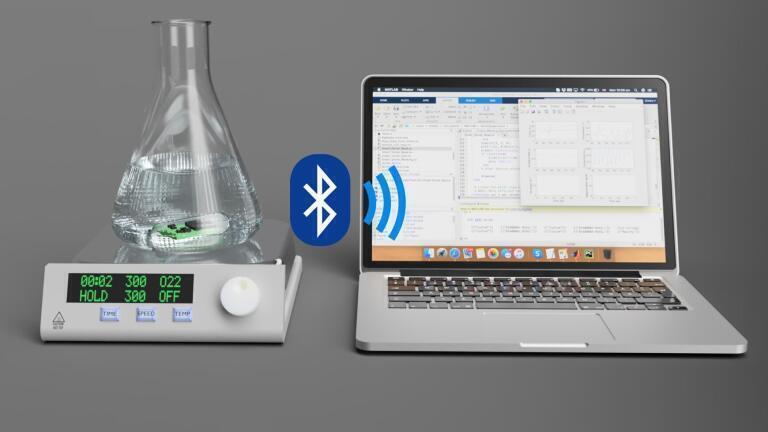
In the paper, ‘Monitoring chemistry in situ with the Smart Stirrer —a magnetic stirrer bar with an integrated process monitoring system’ published in the journal ACS Sensors, researchers from the School of Engineering, the Mathematics Institute and WMG at the University of Warwick present their innovative stirrer sensor.
The small device, called ‘Smart Stirrer’, performed a function of a conventional laboratory stir bar, has an integrated microprocessor and various sensors capable of wireless and autonomous report the conversion of properties of a solution. The advanced sensor stir bar is a capsule shaped magnet encased in plastic.
A beaker filled with a solution is placed on a platform that generates a rotating magnetic field, when the magnetic stirrer is placed in the solution it continuously rotates stirring the liquid. The Smart Stirrer then monitors: colour, transparency, conductivity, viscosity and temperature.
Results are sent to a computer over Bluetooth, and any changes notify the user wirelessly. Although the idea of using magnetic stir bar with integrated sensors may not be entirely new, this new affordable, multi-sensor and easy programmable stirrer sensor device is first in its kind.
The concept is valuable to Research and Design laboratories and pharmaceutical and chemistry manufacturing industries because it allows wireless monitoring of several parameters of a chemical reaction simultaneously.
Dr Dmitry Isakov, from WMG at the University who led the study commented: “We are still continuing research into the stirrer, the next revision of the stirrer sensor that will be smaller size and with a bit more sophisticated sensors. We are collaborating with several chemists from Warwick University. This will help us to understand their needs and help to improve the device.”
ILM 51.6 Sept 2026


 Product directory


.jpg)
.jpg)










.jpg)
.jpg)
.jpg)






.jpg)
