.-Credit---Wikimedia-Commons.jpg)
Research news
Tuberculosis vaccine shows superior immune response protection in nonhuman primates when compared to existing BCG vaccine
A live-attenuated tuberculosis (TB) vaccine candidate in development at Texas Biomedical Research Institute (Texas Biomed) has been shown to afford a more balanced and effective immune response when compared to the only existing vaccine for TB – and the only licensed vaccine on the market – the Bacille Calmette-Guerin (BCG) inoculation.
Developed by Professor Deepak Kaushal, the vaccine candidate involves an attenuated – weakened – strain of Mycobacterium tuberculosis (Mtb), the bacterium that causes TB.
Working to develop an improved TB vaccine for more than 15 years, Dr. Kaushal had already demonstrated that this candidate was 100% protective against a lethal dose of Mtb in rhesus macaques, as long ago as 2015.
“Immunology has changed a lot in 10 years and now we can do much more in-depth experiments that show not just that this vaccine works, but why it is working,” Dr. Kaushal said.
“That is what I am most excited about with this paper – showing the mechanisms that provide this elite [level of] protection, which can inform not only our work but any next-generation TB vaccine.”
TB is the worldwide leading killer by a single infectious pathogen, claiming more than a million lives in 2023 and infecting more than 10 million, according to the World Health Organization.
Dr. Kaushal’s vaccine candidate is called ‘delta sigmaH’ – where he has modified the bacterium by deleting the gene needed to make a protein called sigmaH (sigH). Without sigH, the bacterium is unable to fight off oxidative stress properly and cannot survive in the lungs.
In the current study, Dr. Kaushal and his team at Texas Biomed retested the delta sigH vaccine in a different species of nonhuman primate, cynomolgus macaques, commonly known as the ‘crab-eating’ macaque.
Nonhuman primates are the gold standard to understand how a complete system will respond to a treatment or vaccine, before moving to clinical trials in humans.
“By [testing] in a different species, this shows [the immune response] is not just a one-off and gives us more confidence the vaccine is likely to work in humans,” Dr. Kaushal said.
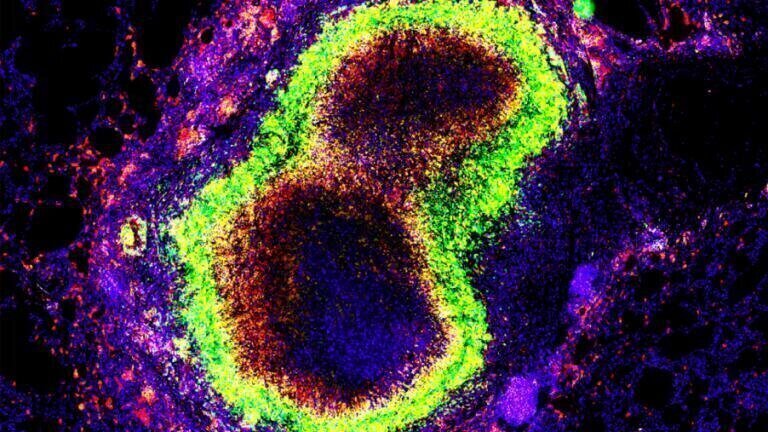
The team used single-cell RNA sequencing and advanced microscopy imaging techniques, such as spatial multiplexed imaging, to compare the immune response between animals vaccinated with BCG and animals vaccinated with the delta sigH vaccine. While both groups were able to control TB, there were dramatic differences in the immune response.
The delta sigH vaccine resulted in a much higher recruitment of critical B and T immune cells to the airways. Importantly, this did not result in excessive, harmful inflammation. Rather, a cascade of responses led to a more balanced and effective elimination of the bacteria.
Notably, the delta sigH group had much lower levels of IDO, a protein known to cause more inflammation and make it difficult for the immune system to combat TB, compared to the BCG group.
There was also a significant difference between the type of interferon triggered. Interferons are proteins that help fight infection. Typically, BCG induces a strong Type I interferon response, which in turns leads to higher levels of IDO. With delta sigH vaccination, interferon gamma, a cytokine that belongs to the other main class of Type II interferons, appears to take a leading role and modulate the immune response.
“With delta sigH, it looks like we are getting all of the good aspects of interferon signalling and none of the bad,” Dr. Kaushal said.
A few more steps of the pathway still need to be pieced together. And other key questions remain: How long does protection last? Is the vaccine as effective delivered via a typical vaccination injection versus directly to the lungs?
The team are also working to develop and test versions of the delta sigH vaccine with more than one gene knocked out so that they can be safely tested in humans.
“The next round of studies are underway. While we are still years away from seeing this vaccine in the clinic, these latest results are giving us more insight to fight this insidious disease,” he concluded.
For further reading please visit: 10.1038/s41467-025-57090-4
ILM 51.6 Sept 2026



 Product directory













,-photo-Karin-Allander.jpg)





.jpg)
