Research news
Researchers at the University of Cologne have identified a potent antibody – 04_A06 – which neutralised nearly all tested HIV strains and eliminated viral load in mouse models, offering hope for next-generation therapies and prevention strategies
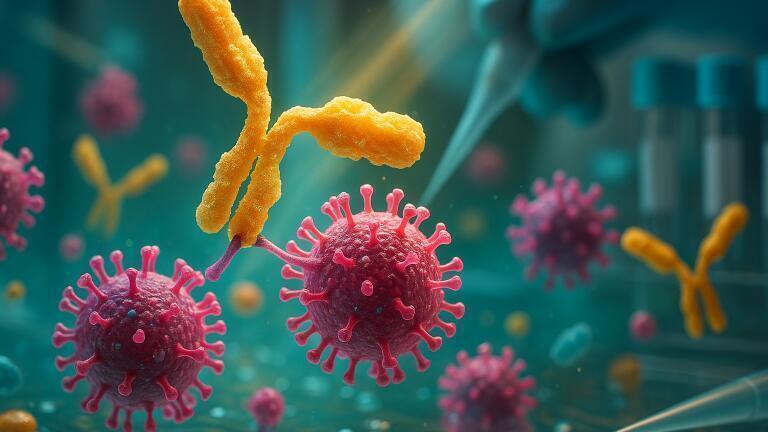
An international team led by researchers at the University of Cologne, in Germany, has identified a potent antibody that could significantly advance efforts to control and prevent infection with human immunodeficiency virus (HIV). The antibody, designated 04_A06, has proved exceptionally effective in preclinical investigations. In laboratory assays, it neutralised 98.5 per cent of more than 300 genetically diverse HIV strains, ranking it among the broadest antibodies ever identified against the virus.
In experiments involving ‘humanised mice’ – animals whose immune system has been engineered to mimic that of humans – administration of 04_A06 permanently reduced the HIV viral load to undetectable levels. Most other HIV antibodies have produced only transient reductions in this model, as viral resistance tends to emerge rapidly.
Antibodies are proteins produced by the immune system to target and neutralise pathogens. Developing one that remains broadly effective against HIV has been a challenge, as the virus mutates at extraordinary speed. Many antibodies therefore neutralise only limited subsets of viral variants. To identify more broadly active candidates – the research team studied blood samples from so-called ‘elite neutralisers’ – individuals whose immune systems naturally suppress HIV replication with exceptional efficiency.
The scientists isolated more than 5,000 individual B lymphocytes – immune cells responsible for antibody production – and generated more than 800 antibodies for testing. Antibody 04_A06 emerged as the most potent and broadly reactive of all those screened, as confirmed through comprehensive neutralisation assays.
“With 04_A06, we have discovered an antibody that not only has exceptionally broad activity but also overcomes the virus’s typical resistance mechanisms.
“This could open up a promising approach for future clinical applications of antibodies against HIV,” said Dr Lutz Gieselmann, a postdoctoral researcher at the Institute of Virology and first author of the study.
Structural analysis revealed an unusual feature that may explain the effectiveness of 04_A06. The antibody possesses an extended amino acid chain that enables it to reach deep into conserved regions of the viral envelope that are typically difficult for immune molecules to access. These regions are critical to the virus’ function and cannot easily mutate without compromising its viability. This property allows 04_A06 to maintain activity even against CD4 binding site escape variants which have rendered other antibodies ineffective.
In addition to laboratory testing, computer models were used to predict the antibody’s efficacy in preventive applications. The models suggested that a single administration of 04_A06 could provide more than 93 per cent protection against infection, indicating strong potential for both therapeutic and prophylactic use.
Professor Florian Klein, director of the Institute of Virology at University Hospital Cologne and leader of the study, highlighted the international nature of the work: “The success of this research relied on close collaboration with study centres in Africa, Nepal and the United States. The next step is to evaluate the antibody’s safety and efficacy in clinical trials, thus paving its way to [move onto] patient care.”
Taken together, the data indicate that 04_A06 could represent a promising candidate to treat people living with HIV and to prevent infection among those at heightened risk. The antibody has been exclusively licensed to Vir Biotechnology, Inc.
The project received support from the Bill & Melinda Gates Foundation, the German Research Foundation (Deutsche Forschungsgemeinschaft, DFG), the German Center for Infection Research (Deutsches Zentrum für Infektionsforschung, DZIF), and the European Research Council (ERC).
For further reading please visit: 10.1038/s41590-025-02286-5
ILM 51.6 Sept 2026




 Product directory



















,-photo-Karin-Allander.jpg)