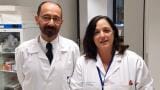
![[From left] Dr. Adam Grippin of the University of Texas, alongside Professor Elias Sayour and Dr. Duane Mitchell both of the University of Florida. Credit: UFL](/assets/file_store/pr_files/66064/thumbnails/images/768w-432h-t-fit-mRNA-vaccine-immunotherapy-cancer-survival-mitchell-grippen-sayour.jpg)
Research news
Patients with advanced lung or skin cancers who received a COVID-19 mRNA vaccine within one hundred days of starting immunotherapy drugs lived significantly longer than those who did not, according to researchers from the University of Florida and the University of Texas MD Anderson Cancer Center
Patients with an advanced lung or skin cancer who received a COVID-19 messenger RNA (mRNA) vaccine within one hundred days of starting immunotherapy drugs lived significantly longer than those who did not, researchers have found.
The observation by researchers at the University of Florida and the University of Texas’ MD Anderson Cancer Center marks a defining moment in more than a decade of research testing mRNA-based therapeutics designed to ‘wake up’ the immune system against cancer. Building on an earlier University of Florida study, the finding also represents a major step towards a long-anticipated universal cancer vaccine to enhance the tumour-fighting effects of immunotherapy.
The conclusions have been derived from an analysis of more than a thousand patient records at MD Anderson. Although the results are only preliminary the effect that the study suggests could have a widespread clinical impact, if validated in a randomised clinical trial.
“The implications are extraordinary – this could revolutionise the entire field of oncologic care,” said co-senior author Dr. Elias Sayour, a University of Florida Health paediatric oncologist and the Stop Children’s Cancer/Bonnie R. Freeman Professor for Paediatric Oncology Research.
“We could design an even better nonspecific vaccine to mobilise and reset the immune response, in a way that could essentially be a universal, off-the-shelf cancer vaccine for all cancer patients,” he added.
Dr. Jeff Coller, a leading mRNA scientist and professor at Johns Hopkins University, said the findings point to yet another way Operation Warp Speed – part of the United States government’s early response to COVID-19 – continues to save lives in ‘unique and unexpected ways’.
“The results from this study demonstrate how powerful mRNA medicines truly are and that they are revolutionising our treatment of cancer,” Coller said.
The study builds upon Sayour’s eight years of work combining lipid nanoparticles and mRNA technology. Molecules of mRNA are present in every cell and carry the genetic information needed to produce proteins.
In July, Sayour’s laboratory reported that a strong antitumour response could be achieved without targeting a specific tumour protein. Instead, the researchers found that they could stimulate the immune system as if it were fighting a virus.
In mouse models, pairing Sayour’s patented experimental ‘nonspecific’ mRNA vaccine with common anticancer drugs known as immune checkpoint inhibitors triggered a strong antitumour response. The experimental vaccine was not specific to the COVID spike protein or to any other viral or cancer antigen but used similar underlying technology. The discovery prompted the question of whether the COVID-19 mRNA vaccine might have a comparable effect.
To investigate, the team analysed data from patients with Stage 3 and Stage 4 non-small-cell lung cancer and metastatic melanoma who were being treated at MD Anderson between 2019 and 2023. The results showed that receiving a COVID-19 mRNA vaccine within one hundred days of starting immunotherapy drugs was associated with a statistically significant improvement in survival.
The most pronounced difference, Sayour said, occurred in patients who, based on their tumours’ molecular characteristics and other factors, were not expected to mount a strong immune response.
As with any observational study, the authors emphasised that the findings require confirmation through a prospective and randomised clinical trial.
“Although not yet proven to be causal, this is the type of treatment benefit that we strive for and hope to see with therapeutic interventions – but rarely do,” said Dr. Duane Mitchell, Grippin’s doctoral supervisor and the Director of the University of Florida Clinical and Translational Science Institute.
“I think the urgency and importance of doing the confirmatory work cannot be overstated,” added Mitchell.
In lung and skin cancers, physicians commonly engage the immune system with drugs designed to ‘release the brakes’ and enable it to recognise and attack cancer cells more effectively. However, in advanced disease stages, most patients respond poorly and have often exhausted other options such as radiation, surgery and chemotherapy.
The study examined records of 180 advanced lung cancer patients who received a COVID-19 vaccine within one hundred days before or after initiating immunotherapy, and 704 patients treated with the same drugs who did not receive the vaccine. Median survival in the vaccinated group rose from 20.6 months to 37.3 months.
Among patients with metastatic melanoma, 43 received the vaccine within one hundred days of starting immunotherapy while 167 did not. Median survival increased from 26.7 months to between 30 and 40 months, and at the time of data collection some patients remained alive, suggesting that the effect might be even stronger. Receipt of non-mRNA pneumonia or influenza vaccines was not associated with any change in longevity.
To strengthen their findings, the Florida researchers used mouse models to combine immunotherapy drugs with an mRNA vaccine targeted at the COVID spike protein. Those experiments showed that they could convert previously unresponsive cancers into responsive ones, suppressing tumour growth.
“One of the mechanisms for how this works is when you give an mRNA vaccine, that acts as a flare that starts moving all of these immune cells from bad areas like the tumour to good areas like the lymph nodes,” Sayour said.
The next step is to launch a large clinical trial through the OneFlorida+ Clinical Research Network – a consortium of hospitals, health centres and clinics in Florida, Alabama, Georgia, Arkansas, California and Minnesota.
“One of our key motivations at OneFlorida is to move discoveries from academic settings out into the real world and the places where patients get care,” said Dr. Betsy Shenkman who leads the consortium.
If confirmed, the findings could unlock numerous possibilities, and the researchers said that an even more effective nonspecific universal vaccine could be developed.
“If this can double what we’re achieving currently, or even incrementally – five per cent, ten per cent – that [time] means a lot to those patients, especially if this can be leveraged across different cancers for different patients,” said Sayour, who is also an investigator with the University of Florida’s McKnight Brain Institute.
The study was funded by the US National Cancer Institute and several charitable foundations. Sayour, Grippin and Mitchell hold patents related to University of Florida-developed mRNA vaccines licensed by iOncologi Inc., a biotechnology company spun out from the university, in which Mitchell holds an interest.
For further reading please visit: 10.1038/s41586-025-09655-y
ILM 51.6 Sept 2026




 Product directory
















,-photo-Karin-Allander.jpg)