Research news
Genetically modified stem cells have survived in mice with humanised immune systems which establishes proof of principle for a potential universal donor cell line
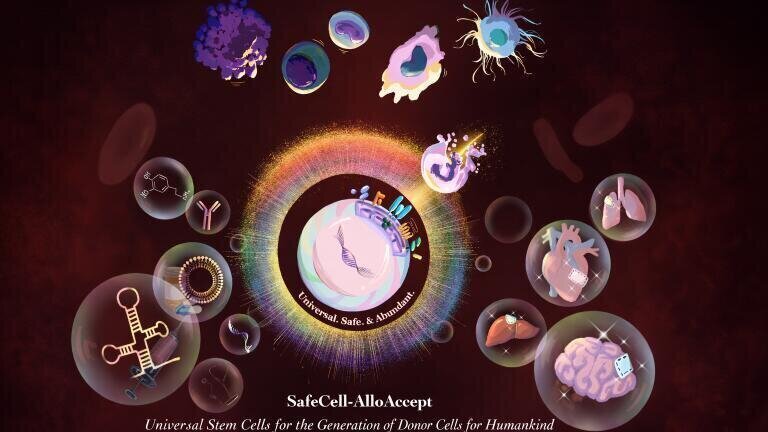
Genetically engineered human pluripotent stem cells have evaded immune rejection in mice reconstituted with human immune systems, with transplanted cells surviving for five months in a stringent in vivo model. The study findings establish proof of principle for the development of a universal donor human pluripotent stem cell line which is designed to withstand immune attack.
The research was led by Professor Danny Chan at the University of Hong Kong, SAR, China in collaboration with Professor Andras Nagy at the Lunenfeld-Tanenbaum Research Institute, Sinai Health, Toronto, Canada. The team introduced eight immunosuppressive genes into a single human pluripotent stem cell line in order to confer resistance to immune-mediated destruction.
Human pluripotent stem cells which have capacity to differentiate into virtually any cell type in the body, present considerable promise for regenerative medicine. However, immune incompatibility between donor cells and recipient remains a persistent barrier to clinical translation.
In this study, the investigators used mice that had undergone reconstitution with components of a human immune system which created a stringent model to assess rejection. When the researchers transplanted unmodified human pluripotent stem cells beneath the skin of these animals, the cells underwent rapid rejection as a result of immunological mismatch.
By contrast, the engineered cells survived until the five-month experimental endpoint. The skin constitutes a particularly immunoreactive environment which makes sustained cell survival notable. The results indicate that the inserted genes enabled the cells to evade immune recognition and destruction in vivo.
To address safety concerns that accompany immune-evasive strategies, the team incorporated an additional genetic safeguard. They inserted a gene that rendered the transplanted cells susceptible to a specific drug which could allow for selective elimination in the event of uncontrolled proliferation.
This ‘SafeCell’ switch functioned as intended in the mouse model. Administration of the corresponding drug halted growth of the transplanted cells which demonstrated that researchers could retain control over cell expansion despite immune cloaking.
Human pluripotent stem cell-derived therapies have entered clinical development in several indications. Recent trials have targeted Parkinson’s disease and type 1 diabetes, among other conditions. In such settings, immune rejection remains a central obstacle. Autologous approaches, in which clinicians derive cells from the patient, can reduce risk of incompatibility. However, the need to generate bespoke cell products for each individual imposes substantial time and cost burdens. Manufacturing complexity also complicates regulatory oversight and scale-up.
Genetic engineering to create a universal donor line offers a different route. Instead of tailoring cells to each patient, researchers aim to modify a standardised cell line so that it can evade immune surveillance across multiple recipients. The present work provides experimental support for this concept in a rigorous preclinical context. Nevertheless, the authors acknowledged that further investigation will be necessary to assess long-term efficacy, genomic stability and tumour risk before clinical application is possible.
The study contributes to a broader effort within regenerative medicine to reconcile immune tolerance with safety. Immune evasion can permit therapeutic persistence, yet unchecked cell survival carries an inherent oncogenic risk. By combining immunosuppressive gene insertion with a controllable kill switch, the researchers have attempted to balance these competing imperatives.
If future studies confirm durability and safety in additional preclinical models and, ultimately, in human trials, engineered universal donor human pluripotent stem cells could streamline regenerative therapies.
For further reading please visit: 10.1016/j.stemcr.2026.102850
ILM 51.6 Sept 2026



 Product directory


















,-photo-Karin-Allander.jpg)








.jpg)
