
Research news
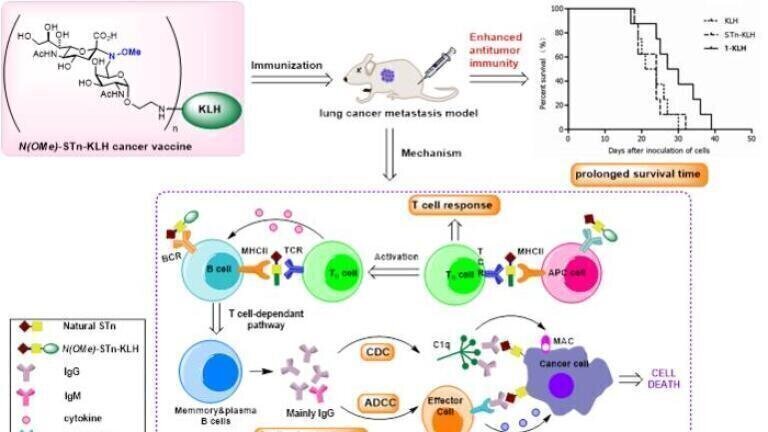
A novel approach to cancer vaccine design has replaced the vulnerable O-glycosidic linkage in sialyl-Tn antigens with a synthetic N(OMe) bond, to yield a stable STn–KLH conjugate that provokes potent antibody and T-cell responses, reduces metastasis size and extended patient survival in preclinical studies animal studies
Researchers have reported the development of a cancer vaccine that has achieved enhanced antitumour immunity in preclinical models.
Tumour-associated carbohydrate antigens (TACAs), which are expressed at high levels on the surface of cancer cells, have long been identified as key targets for the development of vaccines.
These antigens contribute to tumour cell adhesion and metastasis. However, TACAs are usually T-cell-independent antigens and therefore unable to provoke strong immune responses because of their low immunogenicity.
To address this limitation, the team applied a strategy known as modification of carbohydrate antigen structures (MCAS). This approach alters antigen architecture in order to break immune tolerance and increase immunogenicity.
The latest work has introduced a chemical modification to the design of an STn-based vaccine by replacing the natural O-glycosidic linkage, which tends to enzymatic degradation with a synthetic N(OMe)-glycosidic bond.
The modification differs from earlier approaches that altered only acyl groups. By targeting the glycosidic linkage itself – a vulnerability of native STn antigens – the researchers aimed to enhance both metabolic stability and immune potency.
The resulting N(OMe)-STn conjugate resisted enzymatic breakdown yet retained the structural features needed to generate cross-reactive immunity.
During screening, the N(OMe)-STn–keyhole limpet haemocyanin (KLH) conjugate proved to be the optimal candidate. This vaccine elicited high and cross-reactive immunoglobulin G antibody titres against native STn, activated balanced T-helper cell type 1 and type 2 responses and mediated antitumour effects including reduced metastasis and prolonged survival in animal studies.
The antibodies generated were also functional, with the capacity to trigger complement-dependent cytotoxicity and antibody-dependent cell-mediated cytotoxicity against STn-positive tumour cells.
“The failure of earlier vaccines highlighted the difficulty of overcoming immune tolerance to TACAs.
“Our work shows that modification of the glycosidic linkage itself is a powerful way to address this problem,” said the research team.
The findings suggest that the N(OMe)-STn–KLH vaccine offers a promising candidate for further development to treat aggressive carcinomas that express STn.
The study has also established a generalisable MCAS strategy that could be applied to other TACAs to improve cancer vaccine efficacy.
For further reading please visit: 10.1016/j.glycos.2025.100006
ILM 51.6 Sept 2026



 Product directory





















,-photo-Karin-Allander.jpg)








.jpg)
