Research news
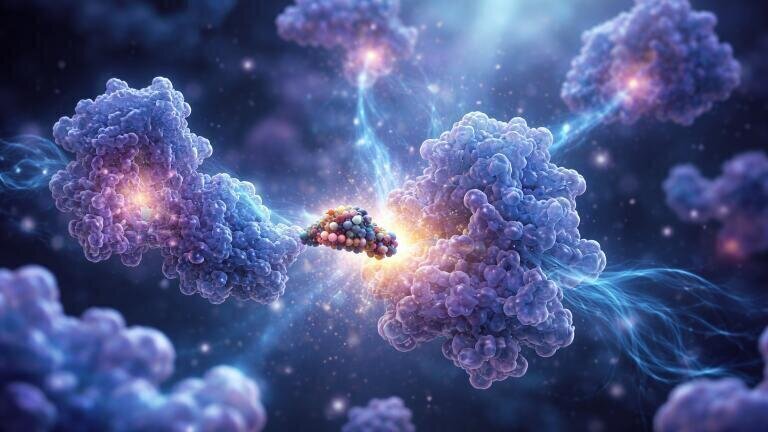
Researchers at the Institute for Research in Biomedicine Barcelona have identified how a therapeutic compound binds to a structurally unstable protein long considered ‘undruggable’, a discovery that could support novel drug designs
Intrinsically disordered proteins lack a stable three-dimensional structure. For decades, this absence of a fixed conformation has led many scientists to regard them as impossible targets for conventional drug discovery. Yet these proteins play central roles in numerous diseases, including several forms of cancer and neurodegenerative disorders which has left large areas of biology beyond the reach of traditional therapeutics.
Researchers at the Institute for Research in Biomedicine Barcelona (IRBB) , Spain, have now identified how a drug molecule can bind to one such protein. The work, which was led by Dr. Xavier Salvatella, group leader of the mechanisms of disease unit at the IRBB, has revealed that drug recognition does not occur when the protein exists alone. Instead, binding becomes possible during a fleeting structural state that arises when several copies of the protein cluster together.
The researchers have shown that intrinsically disordered proteins can form short-lived oligomeric assemblies as they accumulate. Within these transient clusters, portions of the otherwise flexible molecules adopt more organised conformations. These temporary structural features create a molecular environment that allows a drug compound to recognise the protein and attach to it selectively.
“For a long time, these proteins were thought to be impossible to target because they lack a stable structure.
“Our study demonstrates that – at certain moments – they do adopt more organised conformations, and these windows of opportunity can be exploited to develop novel treatments,” said Salvatella, who is also a researcher at the Catalan Institution for Research and Advanced Studies.
Intrinsically disordered proteins participate in many cellular processes, including gene regulation, signal transmission and the assembly of large molecular complexes. Their structural flexibility allows them to interact with many partners. However, this same flexibility has historically complicated drug design because conventional pharmaceutical strategies rely on stable binding pockets within folded proteins.
The IRBB team has shown that this traditional view has overlooked the dynamic behaviour of such proteins. As multiple molecules gather, transient oligomers emerge that briefly display elements of secondary structure. These fleeting conformations provide a structural foothold that allows small molecules to engage their targets.
The researchers combined advanced biophysical measurements with cellular experiments to observe how the compound interacted with the protein during this intermediate state. Their analysis has revealed that the drug selectively recognises the oligomeric assembly rather than the isolated protein chain which explains why the compound can exert its biological effect despite the apparent absence of a stable structure.
“Understanding the mechanism is a key step. It allows us to optimise these molecules and design novel ones that take advantage of these transient states in disordered proteins,” said Dr. Stase Bielskute‑García, the first author of the study.
The findings have provided more than a mechanistic explanation for the activity of this particular compound. They have also offered a conceptual framework for drug discovery programmes that aim to exploit temporary structural states within intrinsically disordered proteins. Such an approach could broaden the scope of therapeutic targets that medicinal chemists are able to address.
The research has also formed the scientific basis for Nuage Therapeutics, a biotechnology company also based in Barcelona, which has been established to develop medicines that target intrinsically disordered proteins. The company applies the strategy described in the study to identify and optimise molecules capable of recognising transient structural states that appear during protein clustering.
Nuage Therapeutics has directed its early research programmes towards small-cell lung cancer and several gastrointestinal cancers. These malignancies frequently involve intrinsically disordered proteins that influence cell growth and tumour progression, yet therapeutic options have remained limited because these proteins have proved difficult to target with traditional drugs.
By exploiting the brief structural organisation that appears within clustered proteins, the company aims to transform a class of targets that the pharmaceutical industry has long regarded as inaccessible. Beyond oncology, researchers anticipate that similar strategies may allow scientists to pursue treatments for neurological conditions and other disorders in which intrinsically disordered proteins play a central role.
If confirmed in further studies, the discovery could mark an important shift in the understanding of protein disorder in biology. Rather than representing an insurmountable obstacle for drug discovery, structural flexibility may offer exploitable moments in which therapeutic molecules can intervene.
For further reading please visit: 10.1126/sciadv.adz74
ILM 51.6 Sept 2026



 Product directory



















,-photo-Karin-Allander.jpg)






.jpg)
