Research news
Researchers in Brazil have reported that ferroin, an iron complex delivered by lipid nanoparticles, eliminates detectable Mycobacterium tuberculosis from mouse lungs after 30 days, suggesting a potential route to shorten therapy and to limit toxicity
An iron-based compound encapsulated in lipid nanoparticles has eliminated detectable tuberculosis (TB) infection in the lungs of mice after 30 days of treatment, according to a study from the Tuberculosis Research Laboratory at the Araraquara School of Pharmaceutical Sciences of São Paulo State University, Brazil. The researchers said the findings had indicated a potential path towards shorter, less toxic and more effective therapies, an aim that has taken on greater urgency as drug resistance to TB continues to threaten progress against the disease.
While TB is a curable disease it still continues to cause large numbers of deaths worldwide. Standard care has relied on prolonged multidrug treatment – typically for at least six months – with daily administration of several antibiotics. When resistance develops, regimens can extend far longer which can erode adherence and increase the likelihood of treatment interruption. Interruption does not merely reduce the chance of cure because it can lead to resistant bacteria selecting which become harder to treat or lead to easier transmission.
“TB is curable but the treatment is long and intense. Patients take several antibiotics every day, which can cause side effects and affect the kidneys and liver,” said Dr. Fernando Rogério Pavan, who advised the study and coordinates drug research within the Rede-TB network – which is Brazil’s national tuberculosis research network.
The authors cited national figures that recorded 84,308 TB cases in 2024 and 6,025 deaths in 2023 (the data being published in 2025) and they argued that the scale of disease continued to justify a search for alternative agents and delivery approaches. Although free treatment is available through Brazil’s national public health network – the Unified Health System – the team said that adherence to treatment can prove especially difficult in vulnerable populations, including people without stable housing or people with alcohol dependence disorders.
“There are patients who [will] stop taking antibiotics in the middle of the cycle which leads to bacterial resistance. As a result, many patients end up with no therapeutic options, as the bacteria [become] resistant to everything available.
“And that person can [then] transmit this resistant strain to another person, creating an even more dangerous cycle,” Pavan said.
The research built on about two decades of work from Pavan’s group to investigate molecules with potential activity against Mycobacterium tuberculosis.
The study, which was led by doctoral candidate Fernanda Manaia Demarqui, saw the team focus on ferroin (FEP) – an iron complex known chemically as [Fe(phen)₃]²⁺. While FEP is not a contemporary pharmaceutical agent, it is a long-established compound and widely used in chemical synthesis. Its selection reflected a drug-repositioning strategy intended to test known substances for therapeutic uses beyond their original context.
“We didn’t invent a new molecule. We took an old, inexpensive, water-soluble substance and tested it for TB.
“When we saw antimicrobial activity, we thought: ‘This could become a thesis,’” Manaia Demarqui said.
In laboratory experiments, the team reported that FEP inhibited the TB bacillus and increased the activity of rifampicin and pretomanid, two medicines used in TB care. They also reported data that pointed to a specific mechanism of action. Microscopy and genomic sequencing, they said, revealed substantial damage to the bacterial cell wall, with genetic changes that mapped to proteins linked to cell-wall biology. On that basis, the team argued that the compound appeared to inhibit cell-wall synthesis, a functional outcome that they compared with the action of penicillin-class antibiotics – even though the chemistry differs.
According to Pavan, microscopy showed that bacterial morphology changed profoundly after exposure to the compound, and genomic analysis identified mutations consistent with disruption of cell-wall pathways. The authors framed this mechanistic clarity as important because it can help researchers predict combination effects with other drugs and anticipate routes through which (future) resistance might emerge.
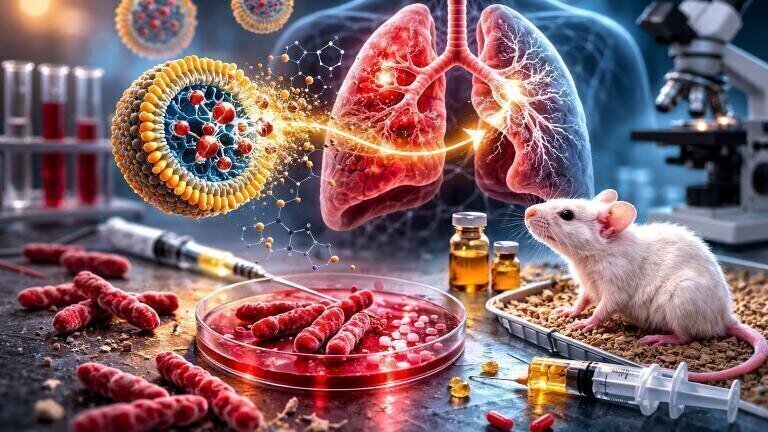
The team then had to address a practical obstacle to clinical use. FEP degrades in the stomach which would limit its usefulness as an oral treatment. To protect the compound and to extend its activity, the researchers encapsulated it in lipid nanoparticles, a delivery format intended to provide controlled release. They described the formulation as simple and inexpensive – built from cholesterol and phosphatidylcholine – and was designed to keep the compound active for longer following administration.
“This capsule protects the substance and allows for [its] gradual release, keeping the compound active for longer. It’s a simple formulation that’s inexpensive and easy to produce,” said Pavan.
To test the approach in vivo, the researchers infected mice with Mycobacterium tuberculosis and divided the animals into groups. One group received conventional treatment, while another received FEP, either as a free compound or within lipid nanoparticles. After 30 days, the team reported complete elimination of the lung infection in animals treated with FEP, whether free or encapsulated. They also reported that this outcome outperformed isoniazid, one of the antibiotics used as standard of care within Brazil’s public health system.
“The result surprised us very positively because we were hoping to see some reduction in the bacterial load. But the tests showed that the compound eliminated everything.
“We found no bacilli in the lungs. In the group treated with the conventional antibiotic, there was a reduction in the bacilli load, as [would be] expected,” he said.
The authors cautioned that the results did not (yet) justify clinical extrapolation. Before any discussion of use in people, investigations will require toxicity studies to identify dose-limiting adverse effects, and pharmacokinetic work to quantify exposure and clearance. And broader efficacy testing in more stringent models, including drug-resistant TB and where there is a chronic infection. Those steps will matter because an agent that clears infection rapidly can still fail as a drug if it cannot reach the right tissues at safe concentrations, or likewise, if it triggers unacceptable off-target effects.
Pavan also highlighted the translational implications of the compound’s intellectual property status. Because FEP is not patented, the team suggested that future development might prove more accessible to the public sector, assuming that later studies confirm safety and efficacy. In that scenario, an inexpensive agent that shortens therapy could improve adherence, reduce the opportunity for resistance to arise and reduce transmission.
“If it works it [may] be possible to transform [FEP] into a drug at low cost,” Pavan said.
If subsequent studies confirm the effect in more demanding disease models and establish a safety profile compatible with dosing in humans, the authors suggest that the work could support a broader shift in TB drug development in which antimicrobial chemistry is paired with effective delivery systems that protect unstable compounds and sustain exposure at the site of infection.
“We already know the main thing: it works. Now, we need to adjust the dosage and duration of use, conduct repeat tests and move forward.
“But seeing total elimination in animal models gives us hope,” Pavan said.
For further reading please visit: 10.1021/acsomega.5c08350
ILM 51.6 Sept 2026



 Product directory




















,-photo-Karin-Allander.jpg)








.jpg)
