Research news
Global breast cancer incidence continues to rise and researchers have reported that nanoformulations of curcumin may overcome longstanding bioavailability barriers to enhance antitumour efficacy, particularly in triple-negative disease
Breast cancer remains the most common malignant tumour among adult women worldwide and it accounts for around 30 per cent of all female malignancies and 15 per cent of cancer deaths in women. According to GLOBOCAN 2022 estimates, there were 2,296,840 new cases globally which equated to an age-standardised incidence rate of 46.8 per 100,000 population, and 666,103 deaths, corresponding to an age-standardised mortality rate of 12.7 per 100,000.
Breast cancer displays marked heterogeneity at genetic, epigenetic, transcriptomic and proteomic levels. Major molecular subtypes include
Triple-negative breast cancer lacks expression of oestrogen receptor, progesterone receptor and human epidermal growth factor receptor 2, which limits targeted treatment options and often confers a more aggressive clinical course.
Curcumin – chemically defined as C₂₁H₂₀O₆ with a molecular weight of 368.13 g/mol – is an extract of turmeric. The molecule exists in keto and enol tautomeric forms. The enol form shows greater solubility in organic solvents, whereas the keto form displays relatively higher solubility in aqueous environments. The central diketone moiety regulates redox modulation activity and enables interaction with multiple cellular proteins, while methoxy substitutions appear to enhance anticancer potency.
Regulatory authorities in the USA have classified curcumin as generally recognised as safe. Beyond its established antioxidant and anti-inflammatory effects, it has demonstrated cancer chemopreventive properties in preclinical models. In breast cancer systems, curcumin has inhibited cell migration, proliferation, adhesion and invasion and has triggered apoptosis.
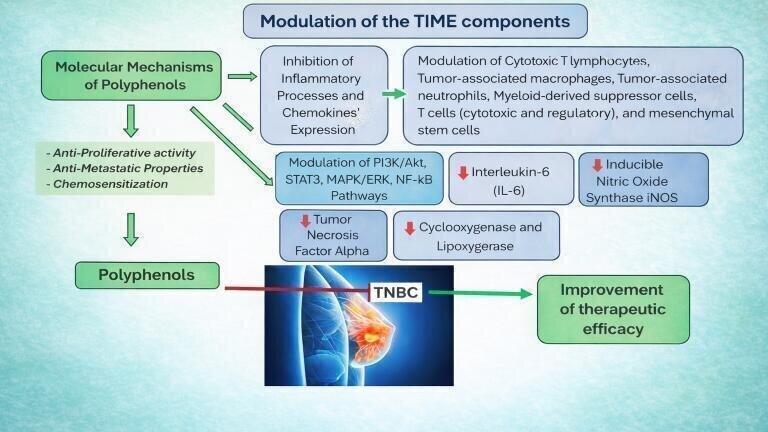
Mechanistically, it has induced G2/M phase cell cycle arrest, increased expression of the pro-apoptotic protein Bax and reduced levels of proliferative signalling proteins such as Akt and mammalian target of rapamycin, as well as the anti-apoptotic protein BCL2. Also, it has activated reactive oxygen species signalling pathways and suppressed nuclear factor kappa B and human epidermal growth factor receptor 2 pathways. Molecular docking analyses have suggested that curcumin can bind to transforming growth factor beta binding pockets through hydrogen bonding interactions.
Evidence indicates that triple-negative breast cancer models respond most strongly to curcumin exposure, with MCF-7 luminal A cells ranked second in responsiveness. Curcumin has also functioned as a chemosensitiser in combination chemotherapy and as a photosensitiser in photodynamic therapy. Combination regimens that paired curcumin with agents such as imatinib or docetaxel have produced enhanced antitumour efficacy in experimental systems.
However, translation into clinical benefit has been constrained by poor aqueous solubility, rapid metabolism, short half-life and low systemic bioavailability. In clinical trials that administered oral curcumin at doses up to 8 g per day, plasma concentrations reached only around 2.5 ng/mL, which reflected rapid metabolic clearance. Co-administration with piperine has increased bioavailability by approximately 2,000 per cent, yet this strategy alone has not fully resolved pharmacokinetic limitations.
Nanotechnology-based delivery systems have therefore attracted substantial attention. Researchers have developed liposomes, polymeric nanoparticles, solid lipid nanoparticles, nanostructured lipid carriers, human serum albumin nanoparticles, nanoemulsions, micelles and carbon nanotube constructs to enhance stability, absorption and controlled release. Encapsulation has protected curcumin from premature degradation and has facilitated slow, targeted drug release within tumour tissues.
Preclinical and early clinical studies have reported encouraging findings. In patients who received 80 mg per day of nano-curcumin for two weeks, investigators observed a reduction in radiation-induced skin reactions during breast cancer radiotherapy. Gum Arabic-curcumin micelles and alginate-curcumin-gold nanoparticles have reduced viability of MCF-7 cells in vitro.
Protein Z-curcumin nanocomposites have increased relative bioavailability by 305 per cent, and lactoferrin-based ternary nanoparticles have enhanced cellular uptake. Human serum albumin-curcumin nanoparticles conjugated with programmed death ligand 1 binding peptides have improved targeting to programmed death ligand 1 expressing breast cancer cells.
Advanced carrier systems have also exploited the slightly acidic microenvironment of tumour tissue, which typically lies 0.5 to 1 pH unit below that of normal tissue.
Nanostructured lipid carriers that incorporate mucoadhesive polymers including polyethylene glycol 400, polyvinyl alcohol and chitosan have improved oral delivery profiles. Curcumin quantum dots formulated with Eudragit RS 100 have significantly inhibited breast cancer cells while sparing normal cells in laboratory studies.
Despite these advances, several translational gaps remain. There is a persistent disparity between basic laboratory research and therapeutic application. Investigators have proposed the use of gene editing platforms, humanised mouse models, three-dimensional bioprinting and patient-derived organoids to bridge this divide. Stronger collaboration between laboratory scientists and clinicians is required to link in vitro findings with clinical practice.
Large-scale production of nano-curcumin formulations presents technical challenges that demand advanced manufacturing approaches. Safety concerns also require careful preclinical toxicology assessment and dose optimisation before widespread clinical adoption.
Curcumin itself has shown a favourable safety profile and demonstrable antitumour properties, yet its limited bioavailability has necessitated high oral doses. Nano-curcumin formulations have exhibited superior efficacy compared with bulk curcumin in experimental models. Encapsulation strategies have enhanced anticancer performance through improved absorption, controlled release and protection from metabolic degradation.
In particular, triple-negative breast cancer appears to represent a promising therapeutic target. Robust preclinical validation and carefully designed clinical trials will now be essential to confirm safety and efficacy before nano-encapsulated curcumin can assume a defined role in routine breast cancer care.
For further reading please visit: 10.14218/CSP.2025.00022
ILM 51.6 Sept 2026




 Product directory


















,-photo-Karin-Allander.jpg)