Research news
Hungarian team has found that dimethyltryptamine – a naturally occurring molecule present in plants and mammals – protects the brain from stroke-related damage by stabilising the blood–brain barrier and reducing inflammation
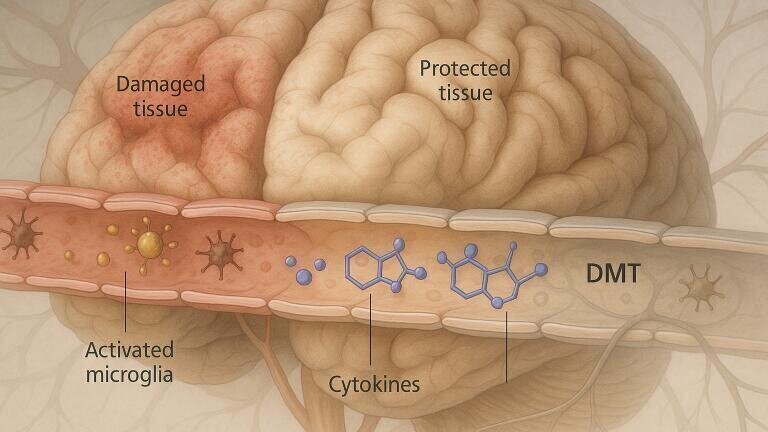
Researchers from the HUN-REN BRC Institute of Biophysics, in Szeged, Hungary, and the Semmelweis University Heart and Vascular Centre, Budapest, Hungary, have reported that the naturally occurring molecule dimethyltryptamine (DMT) significantly reduced brain damage in animal models of stroke by protecting the blood–brain barrier and reducing inflammation.
DMT is a natural psychoactive compound found in a range of plants and mammals, including humans. It is currently under clinical investigation as a neuroprotective agent to aid recovery of brain function after stroke. Although its exact mechanism of action has long been unclear, recent findings have provided important insight into how it may exert its therapeutic effects.
“It is amazing how we can always turn to the natural world to find solutions for health problems,” said Professor Mária Deli, co-lead author from the HUN-REN BRC Institute of Biophysics.
“We found that DMT significantly reduced infarct volume and oedema formation in a rat stroke model,” explained Dr Marcell László, co-first author of the study.
In both cell-culture and animal experiments, DMT treatment restored the structure and function of the damaged blood–brain barrier and improved astroglial cell activity. The researchers also observed that DMT inhibited the production of inflammatory cytokines in brain-endothelial and peripheral immune cells while it also reduced the activation of brain microglia through sigma-1 receptors.
“The therapeutic options currently available for stroke are very limited. The dual action of DMT, protecting the blood–brain barrier while reducing brain inflammation, offers a novel, complex approach that could complement existing treatments,” said Dr Judit Vigh, co-first author of the work.
Since present stroke therapies do not always lead to complete recovery, a DMT-based treatment may represent a promising alternative, particularly when combined with established interventions. The Hungarian team’s findings have supported the development of a potential therapy that addresses both vascular and immune mechanisms in post-stroke injury. Clinical trials assessing the safety, efficacy and long-term effects of DMT in human patients are currently under way.
For further reading please visit: 10.1126/sciadv.adx5958
ILM 51.6 Sept 2026



 Product directory




















,-photo-Karin-Allander.jpg)