Research news
Scientists at the Guangzhou Institutes of Biomedicine and Health, part of the Chinese Academy of Sciences in Guangzhou, China, have mapped the detailed structure of the Nipah virus (NiV) RNA polymerase complex. NiV is a dangerous zoonotic pathogen – meaning it can jump from animals to humans – that causes severe disease with a high fatality rate and currently has no approved treatment. This structural knowledge could be key to designing future antiviral drugs.
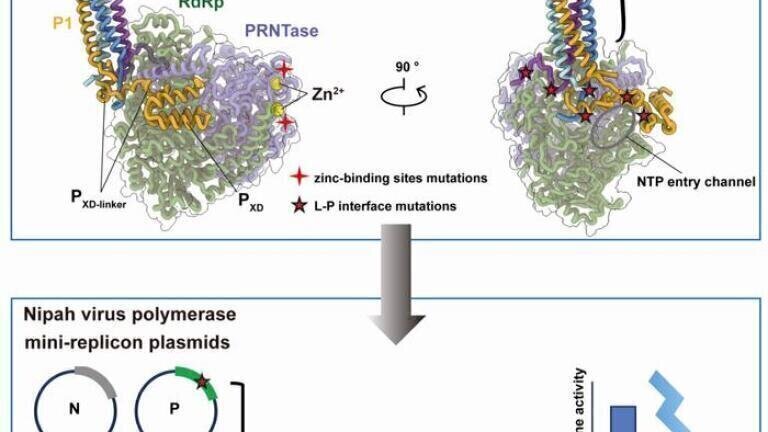
Using cryo-electron microscopy, which allowed the researchers to visualise the biological molecule in fine detail, the team captured two high-resolution images of the NiV polymerase complex in its inactive form. This complex is made up of the L protein, which carries the virus’s main replication machinery, and the P protein, which helps the L protein function correctly.
Within the L protein, they identified two important working parts: the RNA-dependent RNA polymerase (RdRp) domain, which copies the virus’s genetic material, and the polyribonucleotide transferase (PRNTase) domain, which helps process the RNA. They also found that the P protein forms a four-part structure (tetramer) and connects to the L protein through a distinctive contact surface.
The researchers confirmed that two zinc-binding sites in the PRNTase domain are essential for the polymerase to work. These sites are preserved in most related viruses, highlighting their importance. They also observed that flexible parts at the end of the L protein may allow the P protein to help control access to the viral RNA template during replication.
When the scientists deliberately changed the proteins to disrupt these contact points, the virus’s ability to copy its RNA dropped sharply, showing how vital these connections are.
By comparing the NiV structure with similar viruses, the team found shared features, such as certain hydrophobic (water-repelling) contact zones and a specific tyrosine amino acid that acts as a stabilising anchor for the P protein. This conservation across viruses suggests that drugs targeting these regions could have broad antiviral potential.
In summary, the study shows:
These findings deepen scientific understanding of how NiV copies its genetic material and lay the groundwork for drugs that could block this process – an important step towards controlling outbreaks of NiV and related viruses.
For further reading please visit: 10.1093/procel/pwaf014
ILM 51.6 Sept 2026



 Product directory




















,-photo-Karin-Allander.jpg)








.jpg)
