Research news
Researchers at Oregon State University have reported an iron-based nanomaterial that exploits the biochemical environment of tumours to trigger two complementary oxidative reactions inside cancer cells, achieving complete tumour regression in preclinical models
Scientists at Oregon State University, Corvallis, Oregon, USA, have developed a novel nanomaterial designed to kill cancer cells by triggering two distinct chemical reactions inside tumours while leaving healthy tissues largely unaffected. The approach has targeted the abnormal chemistry of malignant cells and has used this environment to selectively induce lethal oxidative stress within tumours.
The study was led by Dr. Oleh Taratula, Dr. Olena Taratula and Dr. Chao Wang at the university’s College of Pharmacy. Their findings have advanced the field of chemodynamic therapy (CDT), an emerging anticancer strategy that seeks to harness the intrinsic biochemical features of tumours rather than relying on external energy sources such as light or radiation.
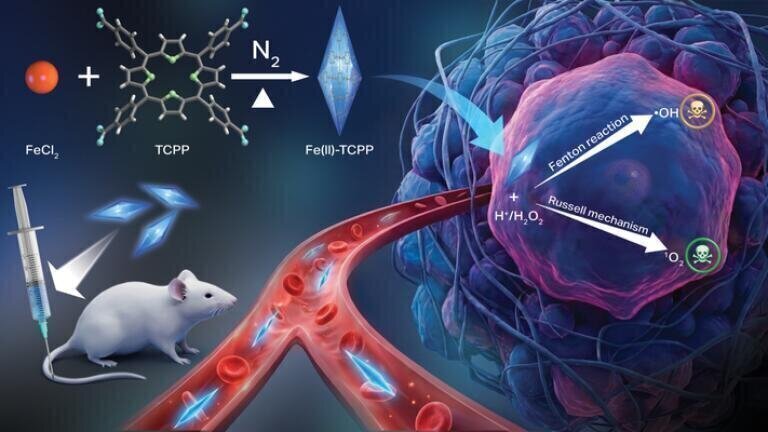
CDT exploits the fact that cancerous tissue differs chemically from healthy tissue. Malignant tumours tend to exhibit a more acidic microenvironment and to contain elevated concentrations of hydrogen peroxide. These conditions provide an opportunity to drive chemical reactions that would not occur, or would occur far less, in normal tissues.
Traditional CDT approaches have relied on these tumour-specific conditions to catalyse the formation of hydroxyl radicals. These highly reactive oxygen species consist of oxygen and hydrogen atoms with an unpaired electron, a configuration that makes them extremely unstable. Hydroxyl radicals can damage cellular components by stripping electrons from lipids, proteins and DNA, ultimately leading to cell death.
More recent designs have sought to extend this strategy by enabling the generation of singlet oxygen, another reactive oxygen species. Singlet oxygen differs from the oxygen molecules found in air because it exists in a single electron spin state rather than the three spin states associated with the more stable ground state. This configuration makes singlet oxygen particularly reactive and capable of inflicting oxidative damage within cells.
“However, existing CDT agents are limited,” said Oleh Taratula.
“They efficiently generate either radical hydroxyls or singlet oxygen but not both, and they often lack sufficient catalytic activity to sustain robust reactive oxygen species production.
“Consequently, preclinical studies often only show partial tumour regression and not a durable therapeutic benefit,” he added.
In the newly reported work, the researchers have described a novel CDT nanoagent based on an iron-containing metal–organic framework (MOF) which consists of porous crystalline materials composed of metal ions linked by organic molecules. They can be engineered with high precision to control chemical reactivity. In this case, the iron-based MOF has been designed to catalyse the production of both hydroxyl radicals and singlet oxygen within the tumour microenvironment.
Laboratory experiments showed that the nanoagent exhibited potent toxicity across multiple cancer cell lines, while causing negligible damage to non-cancerous cells. This selectivity is central to the promise of CDT, as it aims to minimise the collateral harm that often accompanies conventional chemotherapy.
“When we systemically administered our nanoagent in mice bearing human breast cancer cells, it efficiently accumulated in tumours, robustly generated reactive oxygen species and completely eradicated the cancer without adverse effects,” said Olena Taratula.
“We saw total tumour regression and long-term prevention of recurrence, all without seeing any systemic toxicity,” she said.
The results suggest that the dual-generation strategy, combined with the high catalytic efficiency of the MOF, may overcome some of the key limitations that have constrained earlier CDT designs. By sustaining the production of multiple reactive oxygen species within tumours, the nanoagent appears capable of delivering a more decisive and durable therapeutic effect.
Before any transition to human studies, the research team plans to assess the therapeutic efficacy of the nanoagent across a broader range of malignancies. Future work will include evaluation in aggressive cancers such as pancreatic cancer, with the aim to demonstrate that the approach can apply across diverse tumour types and not only within a single disease model.
For further reading please visit: 10.1002/adfm.202529194
ILM 51.6 Sept 2026




 Product directory



















,-photo-Karin-Allander.jpg)