Research news
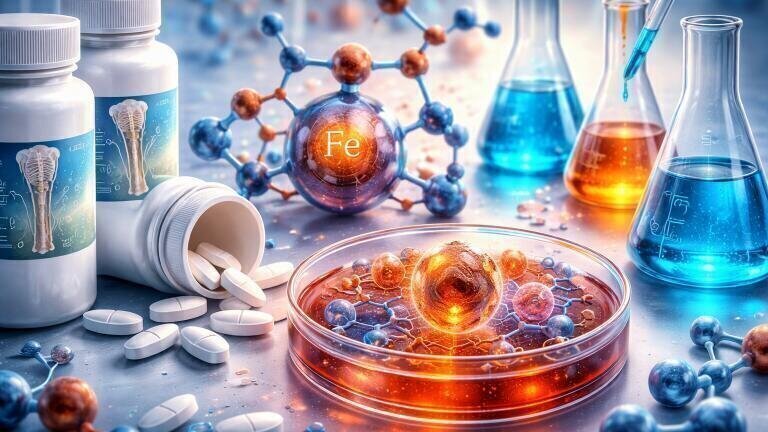
Laboratory research at the University of São Paulo has suggested that two established bisphosphonates may act as iron chelators – a kind of sequestrating agent – with capacity to reduce oxidative stress and damage linked to iron accumulation
Researchers at the University of São Paulo, Brazil, have reported that two drugs widely prescribed to treat osteoporosis may also counteract diseases caused by toxic iron accumulation. In experiments carried out on human cell cultures, the bisphosphonates etidronate and tiludronate bound excess iron, reduced oxidative stress and prevented cellular injury.
“Currently, only three drugs are approved to treat iron overload, known as chelators. They bind to the metal and thus facilitate its elimination by the body.
“However, they tend to have significant side effects, such as nausea and vomiting, which makes it difficult to adhere to treatment,” said Dr. Breno Pannia Espósito, professor at the university’s Institute of Chemistry and author of the study.
The research formed part of the master’s thesis of Julia Tiemy Leal Konno, who received a scholarship from the São Paulo Research Foundation under Espósito’s supervision. Rather than screen large libraries of compounds in search of unexpected effects, the team began with a defined chemical hypothesis. They proposed that bisphosphonates, which contain phosphate-rich groups, might display affinity for iron ions and therefore act as chelators.
Bisphosphonates are routinely prescribed to treat osteoporosis, a condition in which bone resorption exceeds bone formation. This imbalance leads to progressive loss of bone mass and mineral density, which weakens the skeleton and increases the risk of fracture. These drugs inhibit bone resorption and therefore slow disease progression. The researchers reasoned that the same chemical groups that bind calcium in bone might also interact with iron. Because calcium and iron compete in physiological systems, experiments took place in media that contained normal physiological concentrations of calcium in order to reflect realistic biological conditions.
“Iron is essential for oxygen transport and energy production in cells. Its deficiency causes iron deficiency anaemia, the most common type of anaemia. But in excess, it becomes toxic, generating free radicals that damage cells,” Espósito said.
Under normal circumstances, the body controls iron tightly. When present in excess, however, iron can catalyse the formation of reactive oxygen species, or ‘free radicals’. These unstable molecules can damage proteins, lipids and DNA. If production exceeds the capacity of endogenous antioxidants to neutralise them, cells can sustain severe oxidative injury.
Iron overload disorders arise when the body accumulates iron at toxic levels. Genetic conditions such as haemochromatosis, which increases intestinal iron absorption, can drive this process. In other cases, iron overload develops as a consequence of life-saving treatments. Patients with thalassaemia, a disorder that impairs haemoglobin production, often require regular blood transfusions.
While these transfusions sustain life, they also introduce substantial quantities of iron, which the body cannot actively excrete. Over time, this leads to chronic iron toxicity that affects the liver, heart and endocrine organs.
In their cell-based experiments, the USP team demonstrated that etidronate and tiludronate bound iron effectively and limited iron-induced oxidative stress. The compounds performed in a manner comparable to a standard chelator, with substantial capacity to sequester iron and mitigate oxidative damage. The presence of physiological calcium concentrations reduced, but did not abolish, their iron-binding activity.
The researchers also evaluated additional bisphosphonates. Although several of these compounds inhibited iron-induced oxidation efficiently in physiological media, they exhibited greater cellular toxicity. This finding indicated that caution would be necessary if clinicians were to consider repositioning such drugs for iron overload disorders. Strontium ranelate, another antiresorptive agent, failed to demonstrate measurable chelation capacity in the same experimental system.
“The idea behind our work was to exploit this affinity to ‘capture’ excess iron in the body. Although these drugs have already been used to combat bone damage caused by iron overload, this is the first study to propose use as chelators in the absence of bone disease,” Espósito said.
He emphasised that the work remains at an early stage.
“The work brings hope to patients with iron overload, but it’s still too early to talk about clinical applications.
“As the tests were only performed on cell cultures, the results represent more of a proof of concept than a discovery. Many studies are still needed before these drugs can be safely repositioned,” he concluded.
The findings therefore establish a mechanistic foundation for further investigation. If subsequent animal and clinical studies confirm efficacy and safety, established osteoporosis therapies could in future complement or extend the limited arsenal of iron chelators currently available.
For further reading please visit: 10.1007/s10534-025-00777-4
ILM 51.6 Sept 2026




 Product directory



















,-photo-Karin-Allander.jpg)