Research news
Oregon State University researchers have used fluorescence anisotropy to observe – in real time – how copper ions promote amyloid-beta protein aggregation linked to Alzheimer’s disease and how selective chelators can disrupt this process
An Oregon State University scientist and a team of undergraduate researchers have uncovered real-time insights into a chemical process associated with Alzheimer’s disease, a finding that may inform the rational design of future therapeutics. The study has revealed how specific metal ions interact with amyloid-beta proteins to promote aggregation, and how carefully designed chelators can disrupt or reverse that interaction.
The research was led by Dr. Marilyn Rampersad Mackiewicz, associate professor of chemistry in the Oregon State University College of Science, Corvallis, Oregon, USA. The team used a molecular measurement approach to observe, under controlled laboratory conditions, how metals influence the behaviour of amyloid-beta proteins. These proteins form aggregates in the brains of people with Alzheimer’s disease, and those aggregates interfere with neuronal communication.
Alzheimer’s disease remains the most common form of dementia, a chronic and progressive condition that impairs memory and cognitive function. In healthy brain tissue, metals such as copper, iron and zinc fulfil essential biological roles. However, imbalance in metal ion concentrations can alter protein chemistry. Excess copper ions in particular can bind to amyloid-beta in ways that encourage the proteins to misfold and aggregate. Those aggregates accumulate as plaques that disrupt signalling between neurons.
“Too many of some metal ions – like copper – can interact with amyloid-beta proteins in ways that lead to protein aggregation but most experiments have only shown the end result, not the interactions and aggregation process itself,” said Mackiewicz.
“We developed a method that lets us observe those interactions live – second by second – and directly measure how different molecules interrupt or reverse them. It shifts the question from ‘does something work?’ to ‘how does it work, and when?’” she added.
The team applied a technique known as fluorescence anisotropy, a method that measures changes in the rotational motion of fluorescently labelled molecules. When amyloid-beta binds to metal ions or to other proteins, its movement alters in a measurable way. This approach enabled the researchers to track the aggregation process in real time rather than infer it from static end-point measurements.
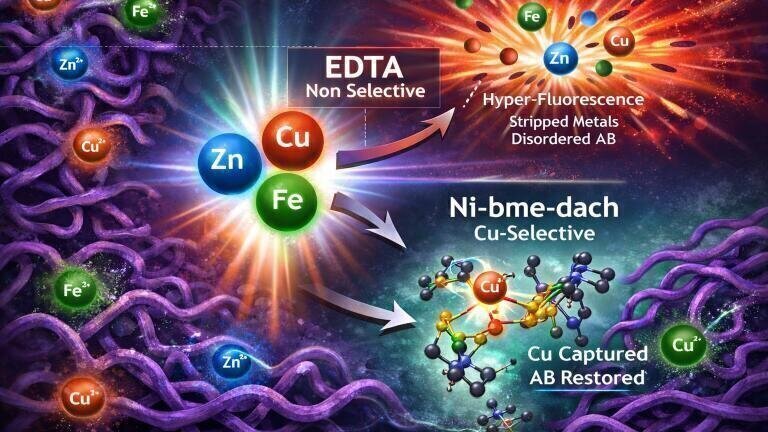
The scientists then introduced chelators – molecules whose name derives from the Greek word for claw – to assess whether they could bind metal ions and prevent or reverse aggregation. One chelator captured metal ions effectively but did so in a non-selective manner. It did not distinguish between metals that promote amyloid-beta aggregation and those that play protective or neutral roles in brain chemistry. Such non-selective binding can disrupt essential metal-dependent processes and may limit therapeutic utility.
By contrast, a second chelator demonstrated a marked ability to bind copper ions selectively. The researchers observed that this copper-selective molecule reduced aggregation linked to copper without broadly stripping other metal ions from the system. That specificity may prove critical for any strategy that aims to restore metal balance in the brain without collateral disruption.
“That kind of real-time insight into how the protein aggregations form and unform is important for designing better treatments and for understanding why some widely used chemical approaches may not behave the way we assume they do,” said Mackiewicz.
“Alzheimer’s [disease] affects millions of families and while clinical treatments based on this work remain years away, discoveries like this can offer genuine hope – with the correct targeting, some of the brain damage might be reversible,” she said.
The work also highlighted the importance of mechanistic understanding in drug development. Many candidate treatments for Alzheimer’s have failed in clinical trials. Incomplete knowledge of how amyloid-beta aggregation initiates and progresses has limited the ability to design molecules that intervene at the correct stage and with sufficient precision.
“Many potential Alzheimer’s treatments fail due to an incomplete understanding of how amyloid-beta protein aggregation occurs. By directly observing and quantifying these interactions, our work provides a roadmap for creating more effective therapies,” she said.
The team has stated that the next phase will require evaluation in more complex biological systems, including cellular models and preclinical studies. While translation to clinical practice remains distant, the ability to visualise, quantify and selectively modulate metal-driven amyloid-beta aggregation represents a significant step towards more rational therapeutic design in Alzheimer’s disease.
For further reading please visit: 10.1021/acsomega.5c11345
ILM 51.6 Sept 2026




 Product directory




















,-photo-Karin-Allander.jpg)