Research news
Researchers have identified a molecular brake that limits DNA replication in healthy cells, revealing how cells prevent a long-suspected replication catastrophe and pointing to a potential vulnerability in rapidly dividing cancer cells
For almost 60 years, scientists have sought to understand why DNA does not replicate uncontrollably every time a cell divides. Cell division is essential for life, yet without strict control over DNA copying, cells would exhaust resources, accumulate errors and fail to survive. The question of how cells impose restraint on this process has remained one of the central puzzles in molecular biology.
Each division requires a cell to copy its entire genetic blueprint and to produce two daughter cells with defined identities, be they liver, brain or skin cells. This process unfolds over roughly 24 hours and follows a tightly choreographed sequence. Cells must first manufacture all proteins and molecular components required for division and place them in reserve before DNA replication begins. If replication were to start prematurely or proceed unchecked, the consequences would be severe, with timing failures and material shortages threatening the integrity of the genome.
Over recent decades, the growing knowledge base has suggested that there must be an intrinsic limiting factor to prevent what biochemists have termed a ‘replication catastrophe’, a state in which uncontrolled DNA copying overwhelms the cell and leads to collapse. Researchers have now reported the identification of such a factor, following detailed studies of replication mechanisms in dividing mammalian cells.
The work has been led by the Kumar Somyajit Laboratory at the Department of Biochemistry and Molecular Biology, University of Southern Denmark, Odense, Denmark with contributions from colleagues at Université Paris-Saclay and the Institute of Biophysics of the Czech Academy of Sciences in Brno.
“If there were no brake of some kind, cells would become stressed, and cell division would fail or stop completely. If cell division in your body were left to itself without regulation, it would undermine the integrity of replicating our genome, causing disease like cancer,” explained doctoral candidate Gita Chhetri, who was first author of the study.
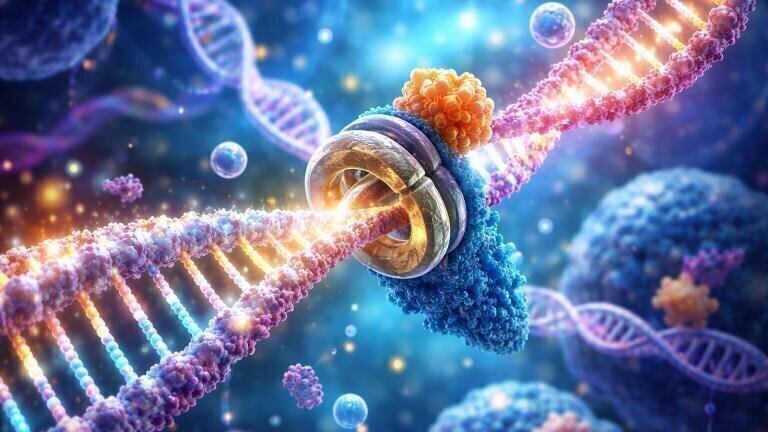
The research focused on the mechanics of DNA replication itself. When cells copy DNA, one strand is synthesised continuously, while the complementary strand is assembled in short segments known as Okazaki fragments. These fragments must then undergo careful processing and assembly to form a continuous DNA strand. This critical stage depends on proliferating cell nuclear antigen – PCNA – a clamp-like protein that binds DNA and coordinates the enzymes responsible for replication.
The researchers found that this assembly step contains a built-in limit in healthy cells. They identified a protein called PCNA-associated factor 15 – PAF15 – as a natural brake that restricts the replication machinery and protects cells from catastrophic failure. Cells produce only a finite amount of PAF15. Once this supply is exhausted, DNA replication halts, thereby preventing excessive or mistimed copying.
PAF15 appears only in higher animals – including humans – which suggests a relatively recent evolutionary adaptation to protect large and complex genomes. Maintaining PAF15 within a narrow range seems to provide a fundamental mechanism by which cells balance efficiency with safety during replication.
In cancer cells, however, this balance shifts. Tumours often drive DNA replication to extremes in order to sustain rapid proliferation. In these cells, PAF15 levels can rise substantially, allowing replication to continue at an accelerated pace. The researchers suggest that this dependence may expose a critical weakness. Interfering with this replication control system could selectively impair or eliminate rapidly dividing tumour cells while sparing healthy tissue.
“Our group is dedicated to exploring and learning about DNA replication and considers our work fundamental research.
“But the significance of this finding means we must also consider its potential value in cancer treatment,” said Dr. Kumar Somyajit, associate professor and leader of the research group.
The team has planned to extend the work to experiments that use cells derived from cancer patients. These studies will take place in collaboration with oncology researchers Dr. Carla Maria Lourenco Alves and Dr. Henrik Jørn Ditzel at the Department of Oncology, Odense University Hospital in Denmark.
“By studying these vulnerabilities through fundamental research, we can learn how to target and kill cancer cells more effectively. There are several types of medication that weaken a cancer cell’s ability to divide, but none that can completely kill cancer cells.
“Our hope is that this discovery could lead to a way to kill cancer cells more effectively. Indeed, devising strategies to drive excessive production of PAF15 could naturally kill cancer cells by disrupting DNA replication,” concluded Kumar Somyajit.
Together, the findings provide a long-awaited explanation for how cells restrain DNA replication and preserve genome integrity. They also illustrate how basic research into the mechanics of life can illuminate unexpected paths towards therapeutic innovation.
For further reading please visit: 10.1038/s41586-025-10011-3
ILM 51.6 Sept 2026



 Product directory



















,-photo-Karin-Allander.jpg)